
September arrives carrying the theme of Love Yourself within our season of Mastery. On the surface, it sounds like a gentle invitation, almost indulgent. But when I step into it, honestly, I feel its weight. Loving oneself is not always bubble baths and affirmations—it is often the hardest task when you are face-to-face with grief.
August has been a month of loss for me, one that cracked me open in ways that I didn’t want to be opened. When grief comes, it is not tidy. It is all-consuming, and for me, it carries an instinct toward self-destruction—toward collapsing inwards, forgetting that I am even allowed to exist in joy. In those moments, the idea of loving myself feels almost impossible and completely unnecessary.
And yet, perhaps that is exactly when love of self becomes the medicine. Not a grand declaration, but a quiet holding. The reminder that even in despair, my humanness is worthy of compassion. But when you are navigating the depths of grief, loving yourself is rarely soft. It becomes a radical act, one that often feels impossible.
Grief has a way of hollowing me out, pulling me toward old instincts of self-destruction. It arrives uninvited and fills every corner of my being, demanding attention. When I grieve, I forget how to love myself or that this is even an option.
And yet, this is the very place where the practice of self-love matters most. Not on the days when joy is easy, but in the hours when life feels unbearable. To love yourself in grief is not a luxury. It is survival, and it feels a lot like surrender.
Grief and the Struggle to Love Yourself
Grief is not tidy. It does not follow the neat stages we are often taught. Instead, it comes like a storm, sometimes gentle and quiet, other times violent and all-consuming. When grief takes over, I find myself unravelling.
Grief can whisper lies: that you are broken, that you are unworthy, that you are alone. And when those whispers get loud, the act of loving yourself feels like swimming against the strongest tide. Some days are unbearably heavy. Others carry small, tender glimpses of relief, moments when the edges soften but the imprint remains. These are the moments when Love Yourself is not a command, but a lifeline.
Perhaps this is where mastery begins—not in holding everything together perfectly, but in choosing, again and again, not to abandon yourself. To love yourself in grief means offering compassion even when you feel shattered. It means staying present to your humanity, even when every part of you longs to escape it. To understand it.
Sophia Above, Gaia Below
In my search for steadiness this past month, I have been reflecting on the archetypes of Sophia and Gaia. Sophia—the wisdom of the heavens, the “as above.” Gaia—the grounding force of the earth, the “so below.”
They seem like opposites: one infinite, one rooted; one ethereal, one embodied. But in truth, they meet within us. We are the place where heaven and earth come together. In our very bodies, in our joys and our grief, we hold both Sophia’s vast perspective and Gaia’s tender grounding.
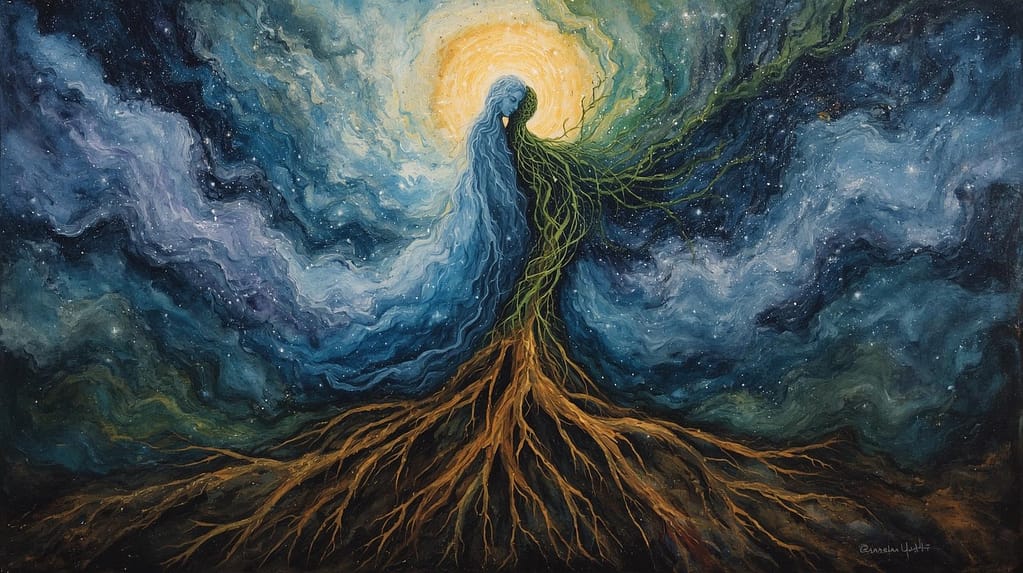
I remember that my grief, as overwhelming as it feels, is part of a much larger story. I am more than my loss. When I allow Gaia to hold me, I remember that my body is alive, breathing, here. The earth beneath my feet whispers that life continues through me, even as it transforms.
To love yourself in grief is to let both of these currents flow through you: the wisdom of the stars and the nourishment of the soil.
What Really Matters
Grief strips away the illusions of importance. Suddenly, the systems we are so entangled in—the striving, the performance, the endless productivity—feel hollow. When you are grieving, none of it matters.
What matters is presence. The raw experience of being alive. The ache of sorrow. The fragile pulse of joy that still somehow emerges in the cracks. The wonder of waking up to another breath, even when you are unsure how you will make it through the day. Even though that same breath seems to be an overwhelming echo in the vastness of loss.
We are not here to serve a system. We are here to experience the fullness of being—to feel both joy and grief, to embody the union of Gaia and Sophia, of joy and sorrow, of love and loss within us. Our emotions, as unbearable as they sometimes are, are not distractions from life. They are life itself.
Mastery as Self-Love
In this light, mastery is no longer about control or perfection. It is not about escaping grief or silencing the pain. True mastery is about presence. It is about staying with yourself, even when it hurts.
To love yourself in grief is to whisper, “I will not abandon you,” to your own heart. It is to recognise that your brokenness does not make you unworthy. It is to soften into compassion, even for the parts of yourself you wish you could change.
Mastery asks us to hold our humanity gently. To see that in our very being—in our joy, our grief, our moments of despair and our glimpses of light—we embody the meeting place of heaven and earth.
Choose not to leave yourself behind
As I step into September, I carry both grief and the quiet strength that comes from choosing to experience it. Loving yourself during grief does not mean feeling better or pretending that the loss doesn’t ache. It means refusing to let sorrow become abandonment.
Our human experience—our joy, our grief, our tenderness, our resilience—is the sacred place where Gaia and Sophia meet. To love yourself is to honour that meeting place. It is to embrace your full humanity, even when it is messy, even when it hurts.
Because in the end, what truly matters is not the systems we are told to serve, but the depth of our experience. The courage to live it fully. The willingness to love yourself, even in the midst of grief. Especially in the midst of grief.