There is something about the first of April that has never felt foolish to me. Not really.
Yes, there is mischief in it. A lightness. A kind of playful wink. But even that feels meaningful. There is joy here. Jest. A brief loosening of the grip. A reminder that life is not only made of duty, seriousness, and getting things right. Sometimes it is the joke that disarms us, it is laughter that opens a doorway. Sometimes joy itself is a form of wisdom.
That is part of what draws me to the wisdom of April Fool’s Day.
Not simply the history of it, though that is interesting. Not simply the folklore, though that too has something to say. What draws me is the way this day arrives at a point in the year that feels alive with movement. The light has changed. The earth is softening. The birds are returning. Spring is no longer a theory. It is happening in the body of the world. While on the other side of the world, things are also softening. The sun is no longer as harsh, and there is a shift. And somehow this day of jest lands right at that threshold, as if to remind us not to take ourselves so seriously that we miss the miracle of renewal all around us. Spring migration in the UK is especially active in April, with returning birds becoming one of the clearest signs that the season has turned.
There is something important about that.
Jest, Joy, and the Softening of the Self
Because joy changes us. It softens the nervous system, interrupts the rigid mind. It lets air into places that have become too fixed. Laughter can take us out of our defences for a moment. Play can loosen our attachment to certainty. Jest can expose where we have become pompous, brittle, or overly sure of ourselves. It can humble the ego and make space for another way of seeing. In that sense, jest is not the opposite of wisdom. It may be one of its forgotten companions.
We live in a culture that often places wisdom on the side of gravity. Serious people are trusted. Structured people are praised. Rational people are rewarded. But life itself does not move in a perfectly ordered line. Nature does not unfold through efficiency. It unfolds through rhythm, season, pause, emergence, decay, and return. It is alive, relational, and surprising. Perhaps that is why joy matters. It reminds us that truth does not only come through force and focus. Sometimes it comes sideways, through delight, through disruption, through the sudden release of a laugh that helps us breathe again.
That is why the spirit of April Fool’s Day feels more meaningful to me than it first appears.
And then there is the timing of it.
There is long-standing doubt around the exact origins of April Fool’s Day. Encyclopaedia Britannica is clear that its true origins are unknown, while noting several theories, including links to calendar reform, older seasonal festivals, and the trickster quality of spring itself, when weather and expectations can shift suddenly.
I find that uncertainty strangely fitting.
This is a day wrapped in ambiguity, and ambiguity is something modern life tends to resist. We want fixed answers, official explanations. We want neat conclusions. But much of life does not reveal itself so cleanly. Or at all for that matter. Nature certainly does not. Meaning often comes in layers, through symbols and resonances as much as through facts. So while the exact origins of April Fool’s Day may remain uncertain, one popular theory continues to speak powerfully at a symbolic level: that the new year was once observed much closer to spring, and that those who kept honouring that rhythm after calendar changes were mocked as fools. Britannica presents that calendar-shift story as one theory among several, not as settled fact.
And still, the symbolism of it lands.
Because in England and Wales, the legal year did once begin on March 25, known as Lady Day. That remained the case for centuries, until 1750, when the Calendar (New Style) Act shifted the legal start of the year to January 1.
That matters to me.
Not because I need the folklore to be fully proven to feel its truth, but because it reminds us that our calendars are not neutral. They are agreements. Structures. Administrative choices. Useful, yes. Necessary, often. But not sacred. The land is sacred. The body is sacred. The season is sacred. And there is something about this part of the year that feels far more like beginning than January ever has.
By the time January arrives, much of the northern hemisphere is still in the grip of winter. The world is quiet, bare, held inward. There can be beauty in that, of course, but not necessarily initiation. Not necessarily emergence. In the southern hemisphere, the rhythm is different again. January carries the fullness of summer rather than the ache of beginning. It is expansive, bright, and alive, but often more ripening than awakening. April is different. In the north, it carries motion. The edges are softening. Birds are crossing hemispheres. Sap is rising. Light is lengthening. The world is saying yes again. And in the south, autumn begins to draw things inward, reminding us that the cycle is always moving in more than one direction at once. All while softening the edges that the summer brought.
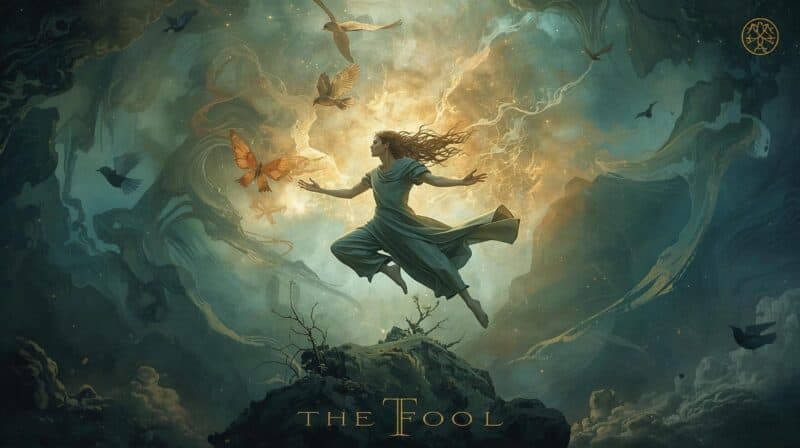
So when I think about the wisdom of April Fool’s Day, I do not think only of pranks. I think of the threshold, of the strange holiness of laughter arriving just as life begins to stir again. I think of the fool as a sacred figure rather than a shallow insult.

The Fool as a Keeper of Instinct
Because the fool, in many symbolic traditions, is not an idiot. The fool is the one who is still close to wonder. The one willing to step beyond the approved script. Who does not yet know every outcome and moves anyway. The one who trusts the road before it has fully revealed itself. To the world, that can look naive. To the soul, it may look like courage.
And how often are the people who feel life most deeply made to seem foolish?
The ones who sense the season turning before anyone else names it. Who trusts instinct before evidence is tidy. The ones who hear the call of the land. Who knows, a chapter is ending before they can explain why. The ones who refuse to override their own body to satisfy someone else’s timeline.
These are often the ones our culture struggles to understand.
We have built a world that teaches us to trust systems more than seasons, deadlines more than rhythms, productivity more than presence, logic more than inner knowing. But what if the fool is simply the one who has not forgotten that there is another intelligence available to us? An intelligence that lives in the body. On the earth. In migration. In the pulse beneath the noise.
Alchemy of Trust and the Return to Nature’s Rhythm
This feels especially alive for me now as we step into a new season in the Wisdom Seekers Society: Alchemy of Trust.
Trust, for me, is not a slogan. It is not passive optimism. It is not pretending that everything will be fine. Trust is more embodied than that. More relational. More alive. Trust is what allows us to follow what is unfolding before we can prove it in full. It is what lets us stay near our instinct long enough to hear what life is asking of us. Trust is what becomes possible when we stop demanding certainty before we agree to move.
And this spring (and autumn), that feels deeply personal.
Here in the northern hemisphere, the birds are returning. At the same time, we are beginning to gather our own things to fly back down south. There is something profoundly tender in being held in that moment. To watch one movement of return while preparing for another. To feel the pull of land. The pull of the season. A pull of belonging. To know, in your body, that life is asking you to trust a call you cannot completely justify to anyone else.
That is where the wisdom of April Fool’s Day comes back around for me.
Perhaps the fool is the one willing to follow the call.

The one willing to look foolish for a moment rather than betray the deeper timing of their own life. Willing to trust that nature knows something. The one willing to let joy matter. Willing to laugh, soften, and be opened by life rather than harden against it.
Because joy is not trivial. It is often a sign of alignment. Not always happiness, not always ease, but aliveness. A loosening. A reminder that we are not here only to perform competence. We are here to participate in life. And participation requires receptivity. It requires enough softness to be moved.
That is what jest can do too. It can interrupt the over-managed self and show us where we have become too controlled to receive. It can remind us that wisdom is not always solemn. Sometimes wisdom arrives laughing; it comes through surprise. Other times it asks us to loosen our grip long enough to discover that we are held by something deeper than our plans.
So perhaps the invitation of this day is not simply to joke, but to remember.
To remember that real beginnings do not always happen when institutions say they should. That our instinct is not the enemy of wisdom. That the natural world is not a backdrop to our lives but a teacher within them. To remember that spring has its own authority. That being made into a fool is not the worst thing if what you are following is true.
As we move into Alchemy of Trust, this is the thread I want to carry with me.
To return to the rhythms of nature. Return to the intelligence of the body. To return to joy as something more than entertainment. A return to jest as something more than silliness. To return to instinct as a living conversation with life itself.
Because there is something about the first of April that has never felt foolish to me.
It feels playful, yes. Alive, like a threshold. It feels like a reminder that not all wisdom comes dressed in seriousness. And it feels like a quiet invitation to trust the deeper rhythm, even when the world does not yet understand it.
Maybe that is the real wisdom of April Fool’s Day. Not that some people were foolish enough to keep listening to a different beginning. But some people were brave enough to trust it.