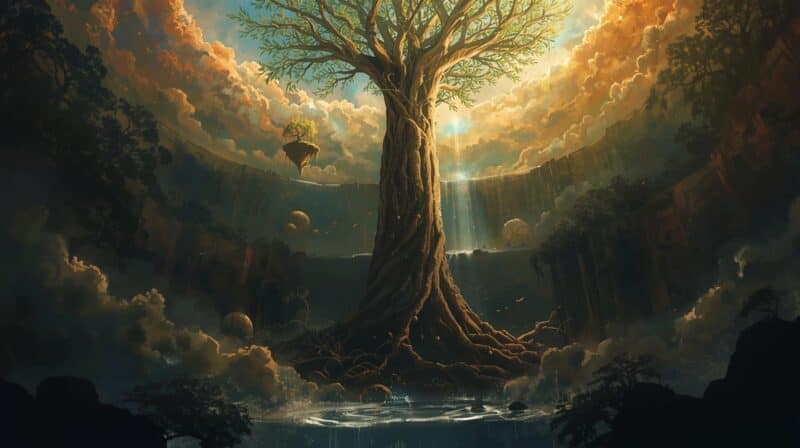
There are some stories that do not simply explain the world. They reorient us within it. The Tree of Emergence has grown, for me, in conversation with the symbolic depth of the Diné emergence story — a story not of one beginning, but of layered beginnings. A story of worlds within worlds, a story of movement, not as escape, but as necessity. A story in which life does not begin fully formed in this world, but arrives here through passage, tension, learning, and ascent.
This is part of what makes the Tree of Emergence feel so alive.
It is not a story of instant illumination. Not a model of “higher self” spirituality that dismisses what came before. It is rooted in the understanding that life unfolds through stages, and that each stage holds both possibility and challenge. What is unresolved does not disappear when we move. It reveals itself differently. What is learned in one world shapes how we enter the next.
In this way, the Tree of Emergence becomes a living symbol for becoming. Not as perfection. Not as performance. But as passage.
At the Root of the Tree
At the root of this work is a reverence for the Diné emergence story and the cosmology it carries. This is not about reducing a sacred story into a neat metaphor for self-development. It is about listening to what the story reveals symbolically. That life moves in layers, that worlds can become too small for what is unfolding within them, and that growth often happens through thresholds we did not expect to cross.
The Tree of Emergence takes shape from this symbolic resonance. It asks us to consider that becoming is not always linear. It is not always comfortable. And it is rarely a simple upward climb. Each world offers something. Each world also reaches a point where it can no longer hold what has been created within it. And so emergence becomes necessary.
Not because the previous world was meaningless, but because life was still moving.
The First World and the Beginning of Emergence
In many retellings of the Diné emergence story, the First World is small, dark, and potent with life. It is not empty, but already inhabited. It already holds beings, forces, and a quality of closeness that feels both intimate and limited. There is a sense here that life begins in containment.
That matters.

Because so much of growth begins in exactly that way. In small worlds, in inherited worlds. In worlds that shape us before we know how to name what is shaping us. These are the early spaces of formation, where we gather instinct, identity, sensitivity, and survival. They are necessary. But they are not always spacious enough for what we are becoming.
The Tree of Emergence honours this.
It reminds us that our beginnings are not wrong because they were limited. They are simply beginnings. The first soil, first root system. The first world that taught us how to live before teaching us how to move.
Moving Through the Worlds
One of the deepest truths in the emergence story is that movement into a new world does not automatically resolve what was unresolved in the old one. This is where the story feels especially powerful to me.
The beings emerge upward into other worlds with more space, more life, more complexity. Yet each world also carries its own tensions. Difference does not guarantee harmony. Expansion does not guarantee wisdom. More room does not mean we have learned how to be with one another, or with power, or with the consequences of what we create.
This is not only mythic truth. It is a human truth.
We move through different inner worlds all the time. The world of childhood, adaptation. The world of self-protection, longing, awakening and deeper responsibility. And every time we enter a new layer of life, we bring ourselves with us. Our patterns come, our memory comes, our gifts come, and our wounds come.
The Tree of Emergence does not pretend otherwise. It suggests that growth is not a clean break from what came before. It is a deepening relationship with it. A willingness to see more clearly what each world has given us and what it can no longer contain.
The Reed as a Living Passage
One of the most beautiful images within the emergence story is that of the reed between worlds. When a world can no longer hold what has been set in motion, a passage appears through living form. Not a machine. Not an imposed structure. A reed. Something organic, growing, vertical, responsive. A channel of emergence.
This image sits at the heart of the Tree of Emergence.
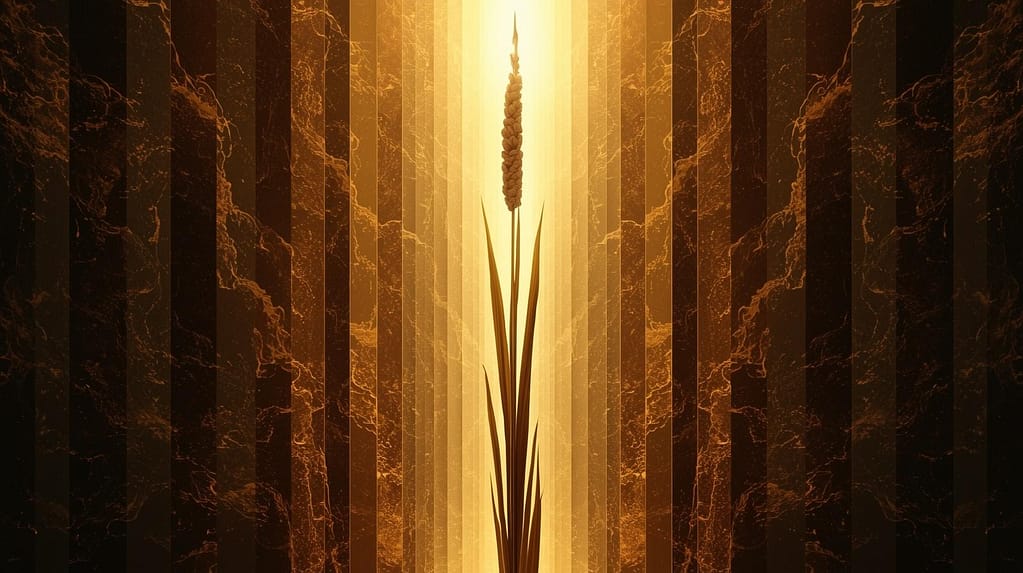
Because it suggests that passage is not always forced, sometimes life itself provides the way through. Sometimes what carries us upward is not domination or certainty, but relationship. Something alive and rooted. Something that grows between levels of existence and offers itself as a bridge.
The reed, beside the tree, becomes a powerful symbol of inner becoming. It speaks of transition that is natural, though not easy. Of ascent that is alive, not mechanical. Of the possibility that when we are ready to move beyond a world that can no longer hold us, the pathway may emerge from life itself.
Why the Tree of Emergence Matters
The Tree of Emergence matters because it offers a different image of growth from the ones we are often given.
So much of modern life is obsessed with outcomes, visibility, achievement, and transcendence. We are encouraged to move fast, become more, fix ourselves, rise above, and keep going. But the tree does not rush. The reed does not force. The worlds do not open because someone declares themselves ready. They open because something deeper has reached its threshold.
This is a slower, truer vision of becoming.
The Tree of Emergence reminds us that roots matter as much as ascent. That what is below the surface is not less important than what is seen. That emergence is not about abandoning the lower worlds, but understanding them. Integrating them. Learning from them and honouring what they formed in us, even as we recognise that we cannot remain there forever.
Growth Is Not Escape
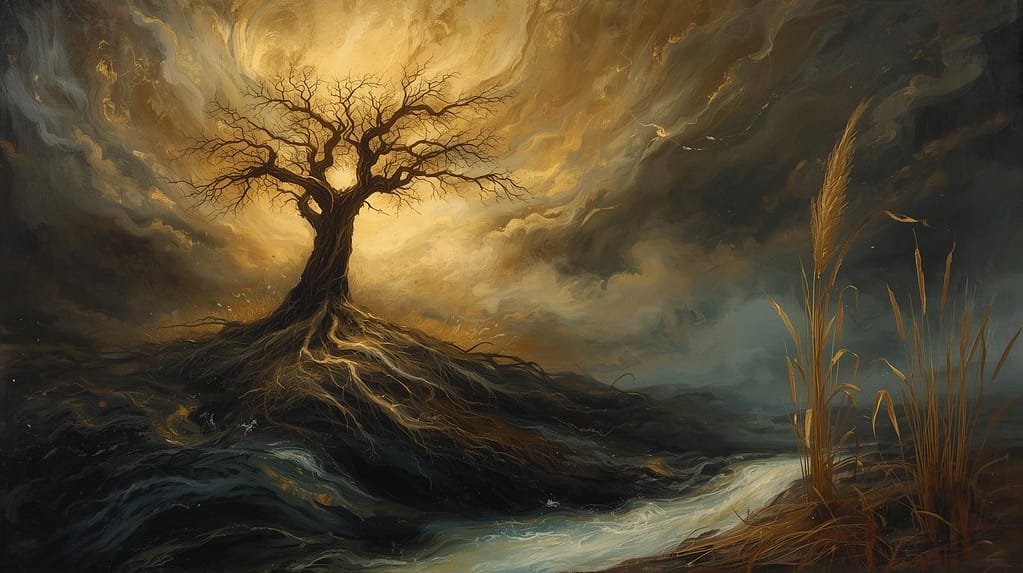
One of the reasons I keep returning to this symbolism is that it resists the temptation to make growth into escape. The journey through worlds is not about leaving behind all difficulty and arriving in purity. It is not about becoming superior to what came before. It is about entering greater responsibility. Greater consciousness, complexity and participation in life.
That is a very different kind of ascent. In the Tree of Emergence, movement upward does not mean disconnection from roots. It means carrying the wisdom of the roots into a new space. Allowing the trunk to strengthen as the branches expand. It means recognising that every visible expression of life depends on what has been tended in the unseen.
This is why the tree is such a profound image here. It does not choose between depth and height. It requires both.
What the Fourth World Asks of Us
The world we live in now is not the end of the story. It is simply the world we are currently responsible for. That, too, feels central to the Tree of Emergence. The present world is not a final destination where all things are resolved. It is a place of continuing relationship. Continuing memory, tension, beauty. Continuing work. We are still learning how to live here. Still learning how to be with what has been inherited. Still learning how to hold the sacred and the human at once.
The Fourth World, in this symbolic sense, asks something of us.
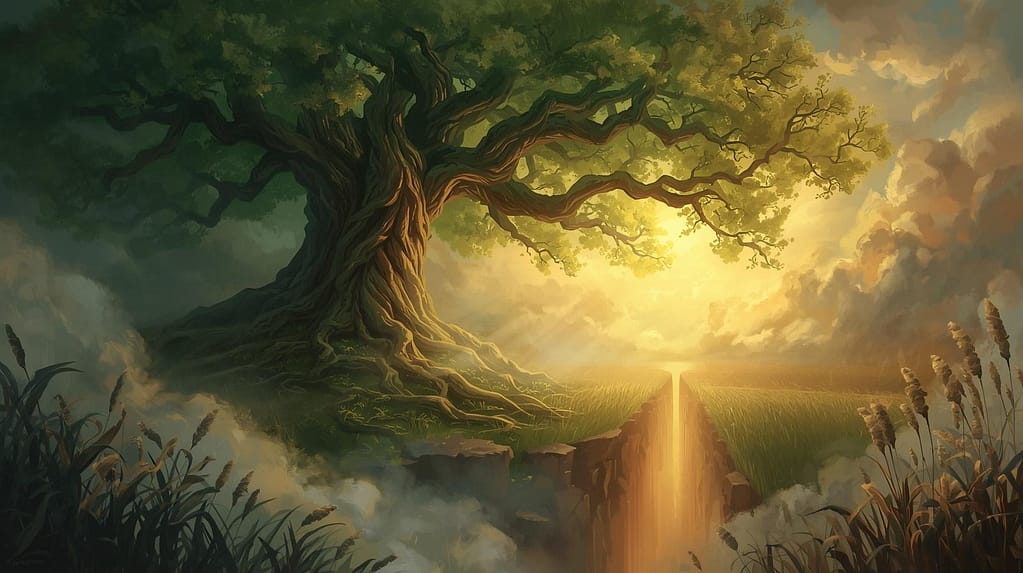
It asks us to be more conscious of what we carry. To pay attention to where we are rooted, to notice when a world, inner or outer, can no longer sustain the life trying to emerge through it. To trust that passage may be possible even when we do not yet see the whole way. And to remember that becoming is not a private performance, but a relational act.
The Tree of Emergence as Invitation
The Tree of Emergence is, for me, an invitation to live more reverently with the process of becoming. It invites us to ask where we are still living inside worlds that have grown too small. Where tension is asking for attention rather than suppression. Where life is trying to move us, not away from ourselves, but more deeply into truth. It asks us to honour what is beneath the surface and to trust that growth may require both rooting and rising.
Most of all, it reminds us that emergence is not an abstract idea. It is a living process.
A process of worlds within worlds. Of roots and thresholds. Memory and movement. Of the moments when life quietly tells us that we cannot remain where we are, and that somewhere within the structure of what is alive, a passage is already growing.
That is what the Tree of Emergence continues to reveal to me.
Not certainty.
Not perfection.
But passage.
And perhaps that is enough.
The Tree of Emergence presentation explores these themes more deeply through story, symbolism, and reflection. It is an invitation to enter the layered wisdom of becoming and to listen for the living passages within your own life.