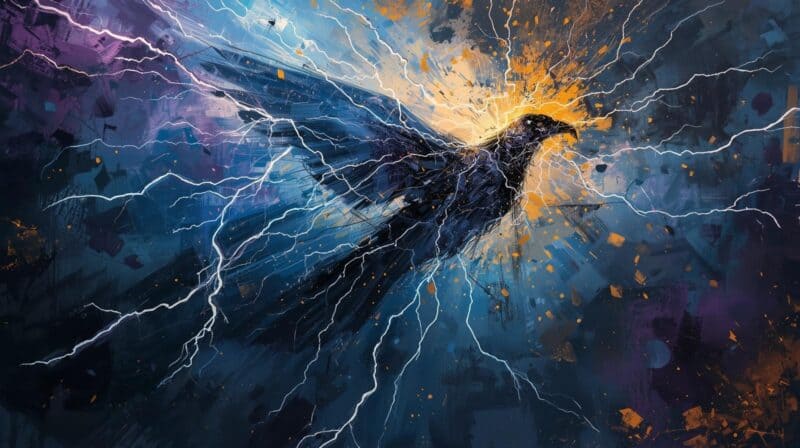
Before the storm arrives, something changes. The air thickens. The birds quieten. The wind shifts direction across the dry earth. In that space we could choose to connect to the lessons from the Lightning Bird.
In many parts of Southern Africa, especially within Zulu and Xhosa oral traditions, storms were never understood as merely weather. They carried presence. Energy. Meaning. Across generations, stories were told of a mysterious being moving through thunderclouds and lightning strikes — a powerful creature often referred to as the Lightning Bird. Even today, storms remain emotionally symbolic because human beings still experience periods where life feels unstable, overwhelming, or charged with unseen energy.
Some said it appeared during violent summer storms rolling across the hills and plains of South Africa. Others believed it carried ancestral force or spiritual power. Some feared it. Others respected it. Yet beneath the mythology lived something deeper: An understanding that transformation often arrives like lightning.
Suddenly. Disruptively. Without permission. Today, the Southern African Lightning Bird myth still speaks directly to modern humanity. Not because we necessarily believe a bird literally travels inside storms. But because the story reflects something deeply human: The moments in life that split us open.
Sudden truths. Emotional upheaval. Identity collapse and awakenings that arrive before we feel ready. The Lightning Bird reminds us that transformation is rarely gentle.
What Is the Southern African Lightning Bird Myth?
The Southern African Lightning Bird myth appears across several indigenous Southern African traditions, particularly within Zulu, Xhosa, and broader Nguni folklore. Descriptions vary depending on region, lineage, and oral retelling, but the Lightning Bird is often associated with thunderstorms, lightning strikes, rain, fire, ancestral energy, and spiritual force.
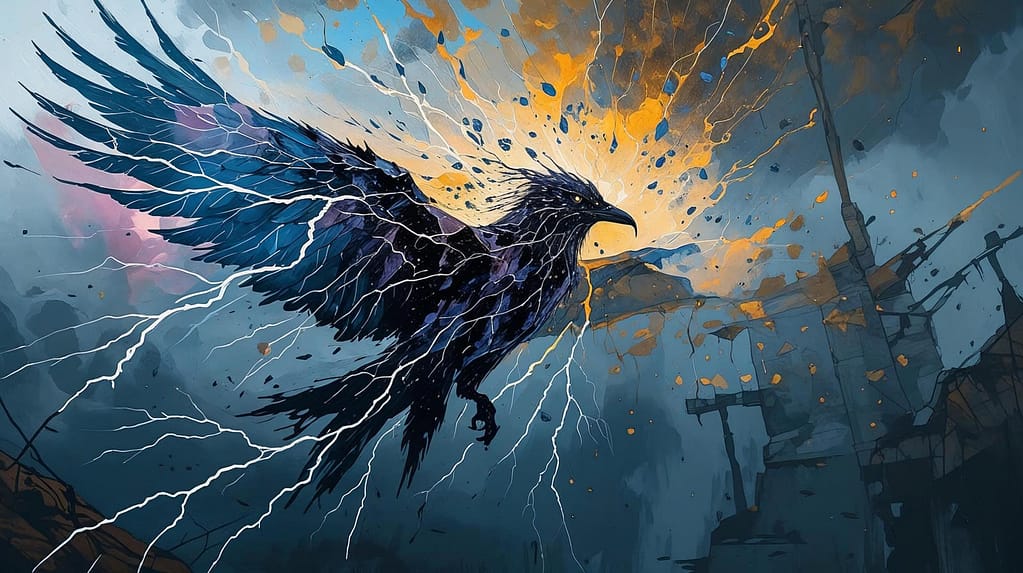
In some tellings, the bird appears black and white. In others, it glows with an unnatural intensity. Certain stories describe it as shapeshifting between bird, spirit, and human form. It was often spoken about in relation to powerful storms that moved suddenly across the South African landscape — especially during the heavy summer thunderstorms familiar throughout regions like KwaZulu-Natal, the Eastern Cape, and the Highveld.
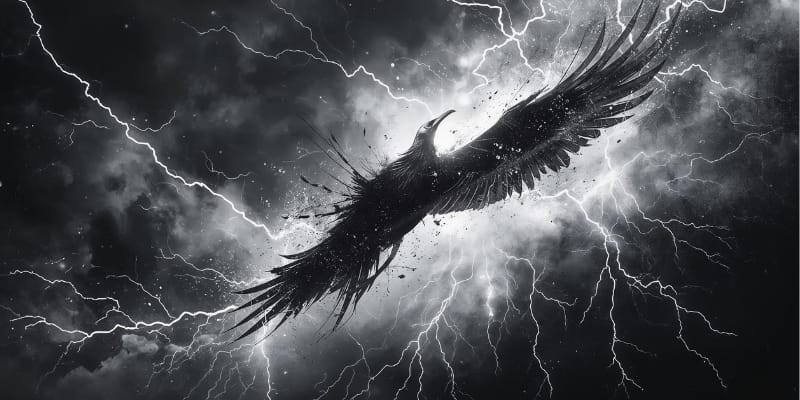
Some elders believed lightning strikes carried intention rather than randomness. Storms were understood not simply as meteorological events, but as movements within a living, relational world. This is important to understand. Many indigenous Southern African worldviews did not separate nature from spirit, emotion, ancestry, or meaning in the way modern industrial cultures often do.
The land was alive. Storms carried symbolism. Animals held messages. Human beings existed in relationship with the seen and unseen worlds simultaneously. The Southern African Lightning Bird myth emerged from this deeper relational understanding of existence.
The Oral Tradition of the Lightning Bird
Like many African myths, the story of the Lightning Bird was carried primarily through oral tradition. It lived through storytelling. Through memory and through generations, sitting together beneath changing skies. Across South Africa, oral storytelling has long been more than entertainment. Stories carried wisdom, warnings, cultural memory, psychological insight, and spiritual understanding. Myths became ways of explaining both the outer world and the inner human experience.
The Lightning Bird myth survived not because people were “primitive” or incapable of scientific thought, but because symbolic stories communicate truths that rational language alone often cannot fully hold. Fear, power, transformation, grief, disruption and awakening.
Stories give shape to experiences that otherwise feel overwhelming or invisible. And in many ways, the Lightning Bird continues to speak because modern humans still experience storms internally.
In oral cultures, especially, storms were experienced collectively and embodied directly. People sat with thunder. They watched lightning split open the sky. They listened to rain on rooftops and felt atmospheric pressure shift in their bodies. Because oral storytelling emerges from lived sensory experience, storms naturally became mythic teachers. In many Southern African traditions, for example, lightning is not merely physical. It can carry ancestral meaning, warning, cleansing, or spiritual potency depending on the cosmology and community context. Storms are relational phenomena — not separate from human life, but woven into it.
This relational understanding appears globally:
⚡ storms connect sky and earth,
⚡ spirit and matter,
⚡ fear and renewal,
⚡ destruction and fertility.
The Symbolism of the Lightning Bird
Lightning as Sudden Awakening
Lightning does not slowly announce itself. It interrupts, it illuminates and it cracks the sky open. Psychologically, Lightning Bird symbolism reflects moments of sudden awareness and transformation. A relationship ending that reveals years of self-abandonment. Burnout exposes a life built entirely around survival and performance. Grief dismantles the identities we thought would protect us. A truth surfacing that can no longer be ignored.
Many people imagine healing as calm and linear. But myths about transformation repeatedly suggest otherwise. Awakening often arrives through disruption. The Lightning Bird myth symbolises the truths that strike through illusion.
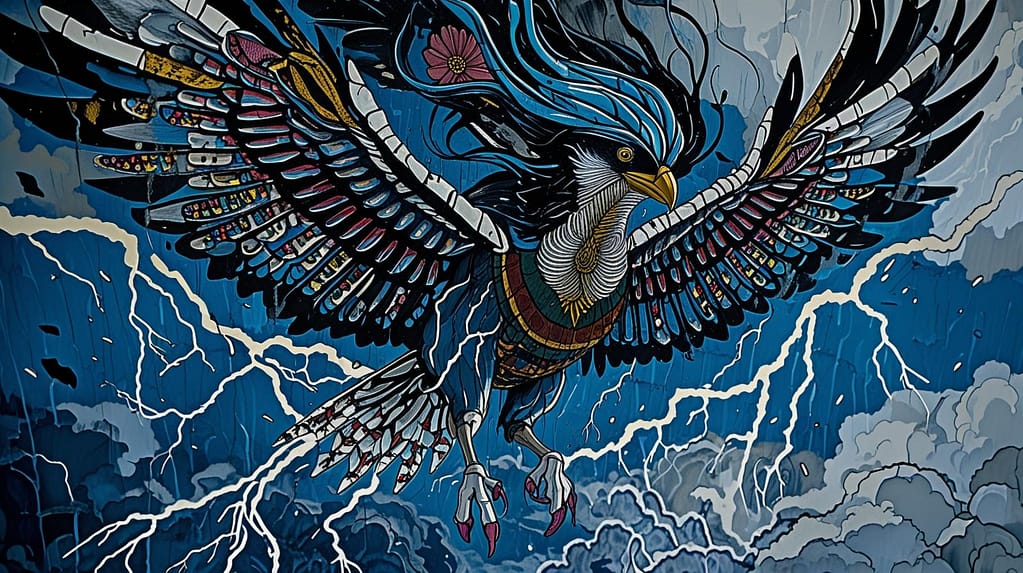
Storms as Symbols of Transformation
One of the deepest aspects of African storm mythology is the understanding that storms are not always punishment.
Sometimes storms clear stagnant energy, sometimes they force necessary change and sometimes they reveal what humans have tried to suppress. Across South Africa, storms can arrive with startling intensity. The sky darkens quickly. Thunder rolls across the landscape. Rain falls hard against dry earth. The atmosphere becomes electrically charged.
Humans experience storms internally in similar ways. Anxiety can feel storm-like. Grief can feel storm-like. Existential collapse can feel storm-like. Sometimes the body senses transformation before the mind fully understands it:
💫 Restlessness.
💫 Fatigue.
💫 Emotional overwhelm.
💫 Tightness in the chest.
💫 The feeling that something old can no longer continue.
Modern culture often treats discomfort as failure. But mythology understands that transformation usually contains chaos. There is often a breakdown before breakthrough. A wilderness before wisdom. A death before rebirth. The symbolism of storms appears across cultures because humans instinctively recognise this pattern psychologically, emotionally, and spiritually.
The Lightning Bird myth reminds us that storms may not always be interruptions to life. Sometimes they are initiations.
The Spiritual Meaning of Lightning
Across global mythology, lightning is frequently associated with revelation, divine force, awakening, and communication between worlds.
In the Southern African Lightning Bird myth, lightning becomes symbolic of energy powerful enough to expose what has remained hidden.
This mirrors the human psychological experience.
There are moments where life suddenly illuminates truths we were previously unable — or unwilling — to see:
⚡Patterns of self-betrayal
⚡Emotional suppression
⚡Relationships that no longer align
⚡Exhaustion hidden beneath productivity
⚡Truth hidden beneath performance
⚡Longings buried beneath obligation
Lightning reveals instantly. Even if only for a moment. And sometimes one moment of truth permanently alters the direction of a human life.
The Fear of Power in the Lightning Bird Myth
In many stories, the Lightning Bird is feared. This fear reflects humanity’s complicated relationship with power.
Not power as domination, but power as intensity. As aliveness, truth and emotional force.
Many people are conditioned to suppress the very parts of themselves that feel too disruptive, too emotional, too intuitive, too alive, or too spiritually sensitive. Especially within modern systems that reward obedience, emotional restraint, productivity, and predictability.
The Lightning Bird symbolism, therefore, represents energies humans often exile within themselves:
🪶 Anger
🪶 Grief
🪶 Creativity
🪶 Intuition
🪶 Passion
🪶 Emotional intensity
🪶 Spiritual sensitivity
🪶 Truth
Yet what is suppressed rarely disappears. It accumulates internally. Like pressure building inside storm clouds. The Lightning Bird myth reminds us that denied power often becomes destructive.
Integrated power becomes transformative.
Mythology as Psychological Language
One reason mythology continues to resonate today is that myths communicate through symbols rather than literal explanation. We can connect to this symbolism much more easily, and regardless of culture and/or language, we get to find a connection.
The psychologist Carl Jung believed myths and archetypes emerge from the collective unconscious — symbolic expressions of universal human experiences. Carl Jung said it best: “Myth is more individual and expresses life more precisely than does science. Science works with concepts of averages, which are far too general to do justice to the subjective variety of an individual life.”
And of course Joseph Campbell: ”All the gods, all the heavens, all the world, are within us. They are magnified dreams, and dreams are manifestations in image form of the energies of the body in conflict with each other. That is what myth is. Myth is a manifestation in symbolic images, in metaphorical images, of the energies of the organs of the body in conflict with each other. This organ wants this, that organ wants that. The brain is one of the organs.”
From this perspective, the Southern African Lightning Bird myth can also be understood psychologically as a symbolic representation of:
💫 Awakening
💫 Shadow work
💫 Emotional disruption
💫 Transformation
💫 Unconscious truth
💫 Spiritual initiation
The storm outside mirrors the storm within. This is why myths survive across centuries. Not because humanity remains trapped in superstition. But, because symbolic stories help people navigate experiences that rational language alone cannot fully explain.
Loss, fear, transformation, death, mystery and meaning. The Lightning Bird gives symbolic form to these experiences.
The Lightning Bird and Shadow Work
The Southern African Lightning Bird myth aligns deeply with modern psychological concepts like shadow work. Shadow work involves exploring the hidden, rejected, or unconscious aspects of ourselves — often the parts we were taught to suppress in order to belong or survive. The emotional storm many people experience during healing is not always evidence that something is wrong. Sometimes, it is evidence that something true is finally surfacing.
The Lightning Bird, therefore, becomes symbolic of the psyche attempting to restore balance. When humans disconnect from emotion, intuition, grief, embodiment, creativity, or authentic self-expression, pressure accumulates internally. Eventually, life creates storms to reveal what can no longer remain buried.
This may appear as:
🪶 Burnout
🪶 Anxiety
🪶 Emotional collapse
🪶 Relationship breakdowns
🪶 Identity shifts
🪶 Existential crisis
🪶 Sudden life changes
🪶 Spiritual awakening
The myth reminds us that disruption can sometimes become the beginning of wholeness.
Indigenous Southern African Wisdom and Relational Consciousness
The Southern African Lightning Bird myth also reflects a profoundly relational worldview still present within many indigenous African philosophies. Human beings were not seen as separate from nature. The world was participatory.
Storms held meaning. Land carried memory. Animals embodied symbolism. Ancestral consciousness remained woven into everyday life.
This differs dramatically from modern mechanistic worldviews that often reduce reality into disconnected systems focused primarily on productivity, efficiency, and control. The loss of symbolic and relational thinking has psychological consequences.
Humans become disconnected from:
✨ Nature
✨ Body wisdom
✨ Emotional awareness
✨ Intuition
✨ Cycles and rhythms
✨ Collective meaning
✨ Spiritual imagination
The Lightning Bird myth invites a remembering. Not necessarily through abandoning science or rational thought. But through recognising that human beings are symbolic, emotional, embodied, meaning-seeking creatures — not machines.
In oral cultures, especially, storms were experienced collectively and embodied directly. People sat with thunder. They watched lightning split open the sky. They listened to rain on rooftops and felt atmospheric pressure shift in their bodies. Because oral storytelling emerges from lived sensory experience, storms naturally became mythic teachers.
In many Southern African traditions, for example, lightning is not merely physical. It can carry ancestral meaning, warning, cleansing, or spiritual potency depending on the cosmology and community context. Storms are relational phenomena — not separate from human life, but woven into it.
This relational understanding appears globally:
💫 storms connect sky and earth,
💫 spirit and matter,
💫 fear and renewal,
💫 destruction and fertility.
The Lightning Bird and Collective Humanity
The symbolism of the Lightning Bird feels especially relevant today. Humanity itself feels electrically charged. Across the world — including South Africa — people are moving through collective storms:
🪶 Emotional exhaustion
🪶 Institutional distrust
🪶 Identity fragmentation
🪶 Ecological anxiety
🪶 Spiritual disconnection
🪶 Information overload
🪶 Rising loneliness and alienation
Systems are cracking. Old narratives are collapsing. People are questioning ways of living that no longer feel sustainable or human. From a symbolic perspective, the Lightning Bird represents collective awakening. Not comfortable awakening. But disruptive awakening. The collapse of illusion. The exposure of imbalance. The confrontation with truths humanity can no longer avoid. And yet storms also create possibility.
Lightning clears. Rain renews dry ground. Old structures fall apart so something new can emerge. Perhaps humanity is not only falling apart. Perhaps something hidden is being revealed.
Lessons From the Southern African Lightning Bird Myth
The Southern African Lightning Bird myth offers several profound lessons for modern life.
1. Transformation Is Rarely Comfortable
Growth often disrupts the identities, relationships, and structures we once depended on. Take the hero’s journey or the alchemical process. Often we need breakdown before we have breakthrough.
The Southern African Lightning Bird myth reminds us that transformation is not always soft or graceful. Sometimes awakening arrives through rupture. Through endings. Through the collapse of certainty. Much like a storm rolling suddenly across the South African landscape, real change can feel disorientating before it becomes clarifying.
Modern culture often sells healing as calm, linear, and aesthetically pleasing. But mythology tells a different story. Before rebirth, something usually has to break open. The Lightning Bird symbolises those moments where life can no longer continue unchanged — where the old self begins falling away so something more honest can emerge.
2. Suppressed Truth Eventually Surfaces
Emotions, intuition, grief, creativity, and truth cannot remain buried forever.
The Lightning Bird myth reflects what happens when human beings disconnect from their deeper emotional and spiritual reality. In many traditions, storms represented energy building over time — pressure gathering until release became inevitable.
Psychologically, humans experience this too. Suppressed grief becomes exhaustion. Ignored intuition becomes anxiety. Unspoken truth becomes emotional tension within the body. The myth reminds us that what is denied does not disappear. It waits. Like thunderclouds gathering on the horizon.
Eventually, life creates moments that illuminate what we have been unable or unwilling to face. And although this can feel frightening, revelation is often the beginning of healing.
3. Storms Can Carry Meaning
Not every difficult season is punishment. Some storms become initiation.
One of the deepest insights within African storm mythology is that disruption is not always meaningless. Storms clear, reveal and transform landscapes.
The Lightning Bird myth invites a different relationship with difficulty. Rather than seeing every painful season as failure, punishment, or personal weakness, mythology asks whether certain storms arrive to awaken something sleeping within us.
Across human life, many of the experiences that shape us most profoundly begin as disorientation. Grief, loss, identity collapse,
burnout, heartbreak and awakening.
The myth reminds us that transformation often begins in places we initially resist. Sometimes the storm is not here to destroy us. Sometimes it returns us to ourselves.
4. Humans Need Symbolic Meaning
Myths remain powerful because human beings are not only rational creatures.
We seek story, connection, symbolism, and emotional understanding.
The continued resonance of the Southern African Lightning Bird myth reveals something essential about human nature: people do not live through logic alone. We understand ourselves through stories, symbols, rituals, memory, and meaning.
Modern society often prioritises productivity, information, and measurable outcomes while dismissing mythology as irrational or outdated. Yet humans continue searching for symbolic language because many experiences cannot be fully explained through facts alone.
Love, death, transformation, fear, belonging and mystery. Myths help translate these experiences into something emotionally and psychologically navigable. The Lightning Bird survives because it continues speaking to storms humans still experience internally.
5. Nature Is Not Separate From Us
The Lightning Bird myth reminds us that humans are participants within the living world — not disconnected observers of it.
Many indigenous Southern African traditions understand nature relationally rather than mechanically. Storms are not simply weather events happening “out there.” They are part of a living world humans exist within and alongside.
This worldview contrasts sharply with modern systems that often position humans above nature rather than inside it. The result is not only ecological disconnection, but emotional and spiritual disconnection too.
The Lightning Bird myth invites remembrance: that humans are embodied beings shaped by rhythm, season, land, atmosphere, emotion, and relationship. The storm outside mirrors the storm within. And perhaps part of healing modern humanity involves rebuilding our relationship not only with ourselves — but with the living world we have forgotten we belong to.
Final Reflection: When Lightning Reaches the Soul
The Southern African Lightning Bird myth continues to endure because it speaks to something timeless within human experience.
The fear of change, the force of truth, the emotional storms that transform us and the awakening that arrives before we feel ready. Like lightning itself, transformation can be sudden, disruptive and Illuminating.
Perhaps the Lightning Bird appears whenever life can no longer continue unchanged. Whenever truth becomes louder than survival, the soul demands awakening. The identities we built begin cracking beneath deeper knowing. And perhaps storms are frightening not because they destroy us, but because they reveal who we were becoming all along.
Maybe the deepest wisdom hidden inside the Southern African Lightning Bird myth is this: What if the storms in our lives are not interruptions… but initiations into deeper truth?
Frequently Asked Questions About the Southern African Lightning Bird Myth
What is the Southern African Lightning Bird myth?
The Southern African Lightning Bird myth is a traditional story found within several indigenous Southern African cultures, particularly Zulu and Xhosa traditions. The Lightning Bird is associated with storms, lightning, transformation, spiritual force, and ancestral symbolism.
What does the Lightning Bird symbolise?
Lightning Bird symbolism is often connected to awakening, emotional intensity, sudden truth, transformation, spiritual power, and disruptive change.
Is the Lightning Bird myth literal or symbolic?
Different traditions interpret the myth differently. Symbolically, the story represents humanity’s relationship with transformation, storms, fear, power, awakening, and the uncontrollable forces of life.
Why do storms appear symbolically in mythology?
Storm mythology appears across cultures because storms mirror human psychological experiences such as grief, fear, awakening, transformation, disruption, and renewal. In oral cultures, especially, storms were experienced collectively and embodied directly. People sat with thunder. They watched lightning split open the sky. They listened to rain on rooftops and felt atmospheric pressure shift in their bodies.
Because oral storytelling emerges from lived sensory experience, storms naturally became mythic teachers. In many Southern African traditions, for example, lightning is not merely physical. It can carry ancestral meaning, warning, cleansing, or spiritual potency depending on the cosmology and community context. Storms are relational phenomena — not separate from human life, but woven into it.
Why is mythology still relevant today?
Mythology remains relevant, even more so as symbolic stories help humans process emotional, psychological, spiritual, and existential experiences that rational language alone often struggles to explain. It gives us a mirror to look into, helping us express and understand our own journeys.
Explore More
If you are drawn toward mythology, transformation, symbolism, psychology, spirituality, and deeper dialogue around human experience, explore more through the Wisdom Seekers Society
Together, we explore the myths, philosophies, archetypes, and symbolic stories that continue shaping human consciousness across cultures and time.
As as I might forget to post the monthly myths on social media, or whichever way got you here, make sure to join my email list. I won’t fill your inbox.