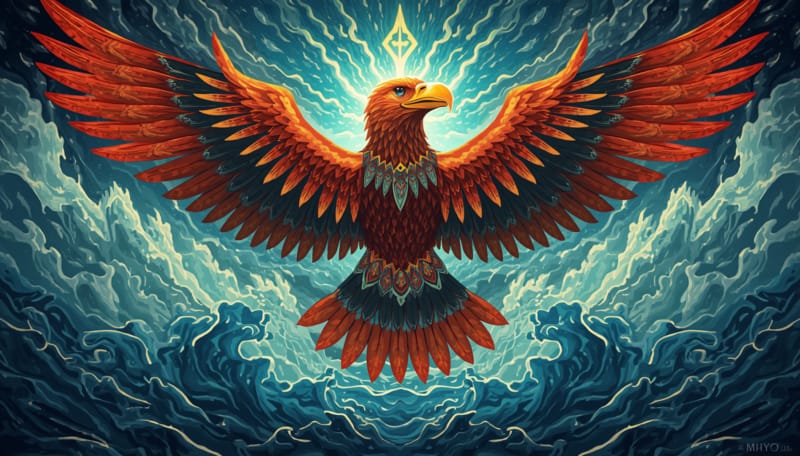
Across cultures and throughout history, human beings have looked to the sky and imagined great beings moving through the clouds. When lightning split the heavens and thunder shook the earth, our ancestors rarely saw these as random events. They saw relationship. Meaning. Presence. There is a certain wisdom carried by the Thunderbird that we only get glimpses of when we are attuned to its message.
Among many Indigenous peoples of North America, one of the most powerful mythic beings associated with storms is the Thunderbird.
Like the Phoenix, Bennu, and Lightning Bird of Southern Africa, the Thunderbird is not merely a bird. It is a symbol through which human beings have attempted to understand forces larger than themselves—creation and destruction, fear and awe, power and responsibility.
For the Wisdom Seekers Society, the Thunderbird offers a rich doorway into our recurring themes of creativity, transformation, mystery, and the relationship between human consciousness and the living world.
Who is the Thunderbird?
The Thunderbird appears in the traditions of many Indigenous Nations across North America, including the Ojibwe Nation, Lakota Nation, Menominee Nation, Ho-Chunk Nation, and many peoples of the Pacific Northwest.
While the stories vary, several themes remain consistent:
- Thunderbird is a powerful supernatural being.
- Its wings create thunder.
- Lightning flashes from its eyes, beak, or feathers.
- It dwells in mountains or the upper worlds.
- It acts as a protector and guardian of cosmic balance.
- It often battles dangerous underwater spirits or serpents.
Unlike many Western mythical creatures that are purely symbolic, the Thunderbird often exists within Indigenous traditions as a living spiritual reality, woven into relationships between people, land, ancestors, and the natural world.
This distinction is important.
For many Indigenous communities, the Thunderbird is not simply folklore. It remains part of a living cosmology.
The Great Battle: Thunderbird and the Underwater Serpent
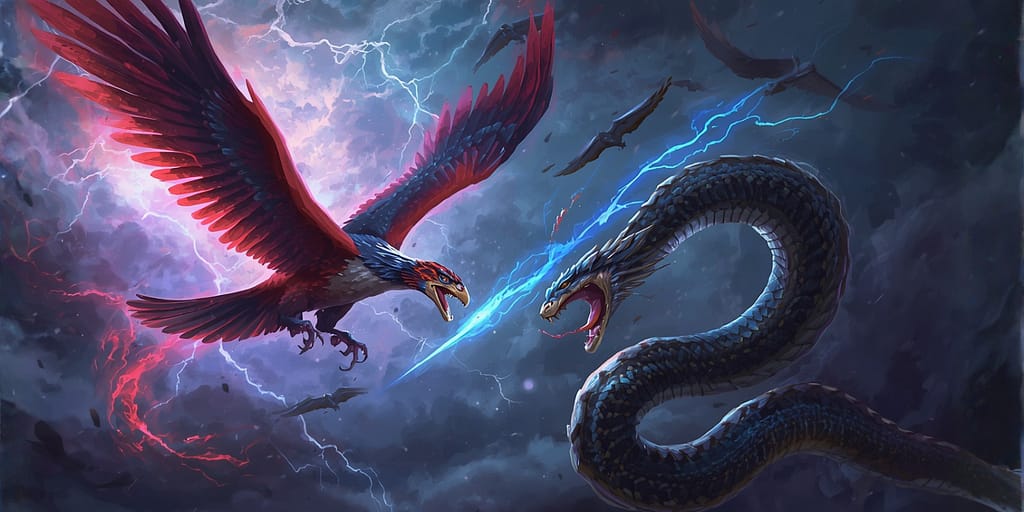
One of the most widespread Thunderbird stories tells of an ongoing conflict between Thunderbird and powerful underwater beings.
The details differ from nation to nation, but the pattern is remarkably consistent. Thunderbird lives in the sky. The great serpents live beneath the waters. The sky and water powers exist in dynamic tension.
When storms gather, thunder rolls, and lightning strikes, many stories interpret these events as manifestations of this cosmic struggle.
From a symbolic perspective, this myth carries extraordinary depth.
The bird represents:
- Vision
- Spirit
- Higher consciousness
- Perspective
- Air and sky
The serpent represents:
- Instinct
- Emotion
- The unconscious
- Hidden power
- Water and depth
Rather than good versus evil, many Indigenous interpretations suggest an ongoing balancing of forces.
The world requires both. Too much sky and we become detached. Too much depth and we become overwhelmed. Wisdom emerges through relationship.
The Story of the Thunderbird
In the beginning, the world was kept in balance by powerful forces. High above the earth, beyond the reach of ordinary people, lived the Thunderbird. It was enormous—so vast that when it spread its wings, the sky darkened. Every beat of its wings created thunder. When it opened its eyes, lightning flashed across the heavens.
The Thunderbird watched over the world from the upper realms. Its duty was not to rule, but to maintain balance between the visible and invisible worlds. Yet deep beneath the lakes, rivers, and oceans lived another power. These were the great Underwater Spirits, often appearing as horned serpents or water monsters. In some traditions, they are known as Mishipeshu or other local names. They possessed immense strength and ancient wisdom, but they could also bring chaos, floods, illness, and imbalance.
Over time, the Underwater Spirits grew powerful and began to threaten the harmony of the world. The Thunderbird saw what was happening. From its mountain home, it launched into the sky. The clouds gathered around its wings. The wind rose and the heavens darkened.
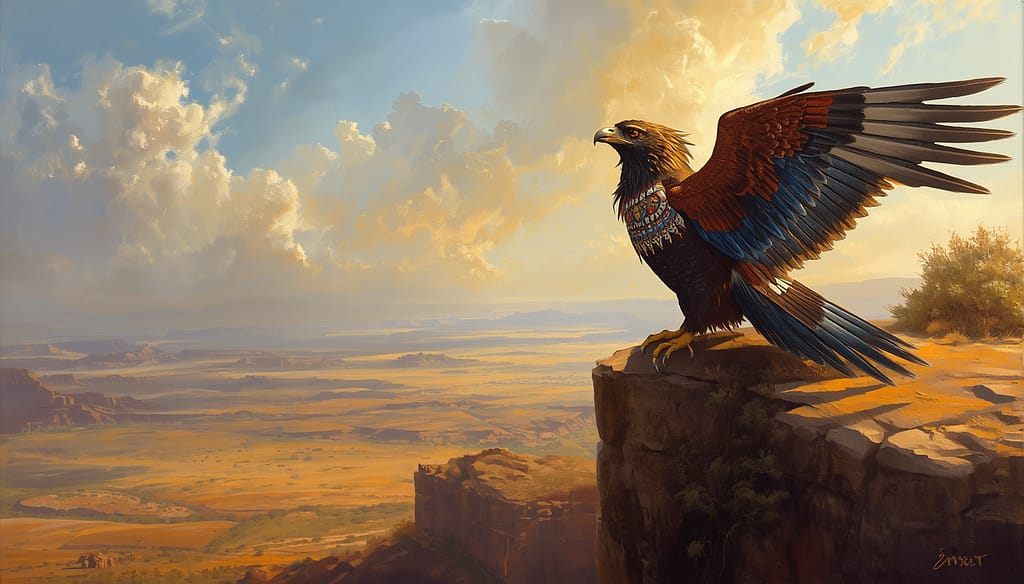
As Thunderbird descended, the great serpents emerged from the waters. The battle began. Thunder rolled across the land as Thunderbird beat its mighty wings. Lightning flashed as it hurled bolts of fire toward the serpents below. Rain poured from the sky. The earth shook.
For people watching from below, every storm became a reminder of this eternal struggle between the powers of sky and water. Sometimes Thunderbird prevailed. Sometimes the serpents escaped into the depths. But neither side could ever destroy the other. The struggle continued because both forces were necessary.
The sky needed the waters. The waters needed the sky. Balance, not victory, was the true purpose of the conflict.
Thunderbird Wisdom as a Symbol of Sacred Power
Thunderbird is rarely portrayed as gentle. It is immense, dangerous and awe-inspiring. Its presence changes the landscape.
This makes Thunderbird an important myth for anyone exploring personal growth. Modern culture often treats power as something to acquire. Many myths ask a different question:
Can you hold power responsibly?
Power itself is neither good nor bad. What matters is relationship to power.
The Storm as a Threshold
This theme connects beautifully to our recent exploration of the Lightning Bird. In many traditions, storms are not interruptions. They are initiations. A storm disrupts certainty. It rearranges familiar landscapes. It forces adaptation. Thunderbird becomes a living symbol of those moments in life when everything feels unsettled.
A career changes, a relationship ends, an identity dissolves, and a new calling emerges.
From the outside, these periods can feel chaotic. From the perspective of myth, they are often thresholds. Something old is dying. Something new is attempting to be born. The storm is not the failure of the journey. The storm is part of the journey.
Creativity and the Thunderbird
One of the most fascinating Wisdom Seekers themes is the relationship between creativity and uncertainty. Creativity rarely arrives through perfect order. It emerges from tension, from questions, from disruption and from not knowing.

The Thunderbird embodies this beautifully. It does not bring calm skies. It brings electricity, movement. and change. The creative process often feels exactly the same. An idea strikes like lightning. Something dormant awakens and a period of instability follows.
Then eventually, new life emerges. The storm becomes the catalyst.
This is why so many cultures associate lightning with revelation, inspiration, and divine communication. Lightning illuminates what was previously hidden. Even if only for a moment.
A Wisdom Seeker’s Reflection
Perhaps the deepest question the Thunderbird asks is: What storm are you resisting?
Many of us spend enormous energy trying to return to certainty. Trying to restore what was. Trying to calm the skies. Yet some storms arrive because something in us is ready to evolve. The Thunderbird reminds us that transformation is rarely comfortable. Growth often sounds like thunder before it looks like wisdom.
The Thunderbird Wisdom reminds us that not every storm arrives to destroy; some arrive to awaken the power, creativity, and wisdom that have been waiting beneath the surface all along.
The Thunderbird sits beautifully alongside the Lightning Bird, Phoenix, and Bennu within our growing exploration of mythological birds. Together, they reveal a recurring truth found across cultures: The birds of myth are rarely about flight alone. They are about what happens when human beings encounter forces greater than themselves—and discover who they become in the process.