It’s Mental Health Awareness Month and social media is buzzing with posts about mental health. People are sharing their stories and showing support to others. However, I find myself cringing at the phrase ‘mental health’ and wonder if it’s only me. Surely it is not a black-and-white situation where you are either (mentally) healthy or (mentally) unhealthy? Who decides what a healthy mind or mental health for that matter, looks like. Is it all perhaps part of a mental health continuum instead?
It kind of comes back to the question of what is normal I suppose. Is there even such a thing? I like to believe there isn’t. Is it really normal to be happy all the time or are we ‘allowed’ to have ups and downs and still fall into the ‘normal’ category. Once you get to define normal, do let me know.
“Normal” is just a setting on your dryer.”
Patsy Clairmont
This is why the mental health continuum might make more sense to some. I think we all touch on the various ends of the continuum more often than we sometimes wish to admit. There are various reasons why we might experience these. Whether they are because of external or internal events, there is usually a reason for these feelings or perspectives.
Understanding Yourself
I must say I have been through quite a few very dark moments in my life and I touch on these feelings even now at times. I was diagnosed with depression in my teens. However, it was at a time when I suffered from anorexia.
For 4 years I struggled with an absolute need for self-destruction. A bit of a chicken-egg argument as to which one came first. At the time medication helped somewhat, but it was a tool to get to a different place on the mental health continuum. A symbolic crutch in a time when I needed it. However, not a long-term solution and had to be replaced by an understanding of self. Not only why, but also that it is part of a cycle, maybe even a continuum?
One of my all-time favourite quotes that have been attributed to some great names, but actually comes from a tweet after a breakup, says it all. Hence strengthening the context of feelings and in effect our ‘mental health’.
Before you diagnose yourself with depression or low self-esteem, first make sure that you are not, in fact, just surrounded by assholes.
@debbihope
It might not even be the other people surrounding you, but could be yourself. How we view ourselves and of course our self-talk is so relevant in this discussion. We tend to fall back into that survival mode so easily. In survival mode, our instincts for self-preservation kicks in. Sadly they haven’t been reprogrammed much from our cave-dwelling days. Unless we learn to tap into our innate curiosity for the unknown and find the confidence to say yes.
Instinctively Letting Go
What are our instincts? Instinct by definition is behaviour that is not based on previous experience or learning. Instead, instinctive behaviour refers to innate actions that we take for self-preservation. However, these instinctive behaviours are often based in fear as this was what the unknown brought us. Whenever I talk or think about these instincts the movie The Croods comes to mind. The first one in particular as I haven’t yet had a chance to watch the second one. I do feel in a modern-day example, our ‘cave’/safe place becomes filled with fear and anxiety. The answer? Curiosity… Say ‘Yes’, even if you are not sure.
Our instincts revert us back to those feelings of anxiety and utter panic. I find this is especially true around two concepts that we have created ourselves. Time and money. Yes, I understand that there is a place for these in the version of life that we have become to believe we need. However, it’s all falling apart at the seams. It has been for a very long time. Those with the money don’t have the time and those who think they have the time might not have the money. That fight or flight instinct that has served us so well suddenly has nothing other than what is created in our minds to fight or run away from. This causes these problems we tend to come back to.
I propose that it’s time to have a look at these instincts as they don’t really serve us anymore. Where do we go though. Our values are based on imaginary concepts (like time and money) and our self-worth seems to be very unreliable. Letting go of what keeps being thrown as ‘the only way’ is a very tricky situation. It takes practice to lose this bit of built-in ‘safety mechanism’. We can call it different things. Maybe linear vs non-linear thinking approach? Do we really need to have a word or structure for it? One thing that has become quite clear to me though is that it takes a bit of brainwashing (as Kat mentions) and room for error.
I chatted a bit about this with Kat Dawes from the Nowism movement recently. Here is a little snippet of our conversation (the full conversation is available in the Wisdom Seekers Society).
Normalising the continuum mentality
I’m currently experiencing one of these darker moments in time. I suppose I should come up with a cool name for it. It is due to my state of mind. Within my mind, I create my reality and although I’m struggling currently, I know that this is often the starting point for some new and fresh to emerge. Or maybe it’s part of the cycle. For me, it’s (at the moment at least) about letting go. A definite theme throughout my life in fact. Letting go of so much. It’s a process. A practice. Once I think I got it, I have a curveball thrown my way. Or is it that I attract the curveball as that is part of the ‘known’.
Letting go of expectations of what society tells me I should think like or feel like. There is a place for sadness on this continuum. Especially when we are looking at these times. Connections, stories around the fire, family get-togethers and all those things that our societies were built on are no longer there.
I can identify why I’m going through these feelings at the moment. I’m recovering from Covid and once again the experience of not being. We inadvertently put expectations on ourselves as entrepreneurs especially. Whether it’s around our workload or our worth. Perhaps the perceptions we have of the connection between these.
Perhaps Carl Jung’s answer should suffice? I do love a lot of what he has to say.
“What you resist persists”
Carl Jung
Letting go of the old paradigms
We live in a world where we have been taught to do (work), have (material) and we’ll be (happy or even ‘mentally well’). So when the first bit of this cycle gets interrupted, it messes everything up. This sequence of behaviour (for a lack of a better word) is where I believe the problem lies. Not being able to do and work and be that ‘productive member of society’ we are supposed to be, puts a huge spanner in the works.
That combined with the fear-mongering that modern marketing and mainstream media equally sling at us, creates these varying feelings of dis-ease and effectively (mental perhaps mostly) disease. All of these elements have been intensified through Covid times. Being unwell or fearful for that matter holds us back. It lets us revert to those times where survival was necessary. Activating those survival instincts and possibly attracting fear.
It’s tough letting go and I think in our nature to hang on to some bits of unease. I mean it can’t all be good… some would say. However, if we persist in learning perhaps we’ll find a way where we can experience things differently. However, this can only happen in collaboration, discussion and tolerance for others’ points of view and perspectives on life. That is how new paradigms and perspectives are formed.
However, we are sidetracked by pronouns and other matters that seem of such little importance to the bigger picture of finding that bit of gold within. I had such a great conversation with Deon Newbronner around this.
Looking at society for guidance can be a very scary thing to do. We have been taught to rely on broken values. Where fast-food chains are more recognisable to young children than their own last names. We are brought up to work hard be successful and show off our ‘riches’. Yet most people that follow this path end up with a midlife crisis or great breakdown at some point along the road. Our value systems are broken and yet we can’t let go of them. We are so accustomed to creating boxes for people and things to fit into that we lose connection with the full person. Even when we are that person. Perhaps especially when we are.
The box culture
It is amazing how much security people find when fitting into a box. Whether you use psychometry or astrology or archetypes or whatever makes sense to you at the time, there will be always aspects of truth in anything you want to find meaning in. Don’t get me wrong any and all of these have a place if used with the right intentions. I suppose that’s where it all starts. The intentions with which we use these tools of awareness will provide you with the relevant (to you at that time) answer. Measurement is one thing. Interpretation another.
There has definitely been a more accepting culture to using tools in personal awareness and development. Although there sadly also perpetuates the boxing culture. We all do it… “Oh he’s a Taurus, I don’t get along with Tauruses”. Don’t even get me started when someone quotes their Myers Briggs ‘box’. Who am I to judge, but I really think the MBTI has damaged the reputation and purpose of psychometry as a science. I would almost say that it has damaged so much more.
I don’t believe even Jung intended to do that with his archetypes. It’s funny how little mention so much of his work around dreams and the subconscious gets.
What if we shake this up a bit and start with the be. Working on being kind to ourselves and sometimes (or often perhaps) spending the day doing what we love. Even though we feel like assuming the fetal position and crying ourselves to sleep.
I absolutely love John Roedel’s work and every now and then the algorithms favour me and his work pops up in my Facebook newsfeed. This one was particularly apt around this topic specifically:
I used to carry this note
in my pockets wherever
I went as a warning to quit
comparing myself to others
I used to be so obsessed
with making my life
resemble everyone else’s
eventually
~ after a lot
of needless suffering I
discovered that my desire
to look normal was killing me
it was death by conformity
my love,
don’t waste time
like I did
trying to fit in
remember that
in the entire history
of the cosmos
there will only be
one you
your life is a singular
event
you are the rarest
wonder the universe
will ever know
your life is a song that
will only be sung once
every breath you
take makes history
don’t chase the fake
rainbow of comparison
you won’t find
any gold there
because you are
the gold
my love,
be unashamedly you
don’t clone your life
own your life~ john roedel
Connecting the dots to find the breathe
We all crave connection. Yes all of us. On different levels and in different ways. Yet it is a human default. We just don’t always know how to connect with some people and therefore we give them a label. Once again just to affirm that ‘I’ am right and ‘you are different’.
This, for me, seems to be a lot of the reasoning behind neurodiversity labels specifically. If you don’t have the label, then you don’t get the support. Should the support not be a given as we celebrate our own uniqueness. Just because I (or my child) don’t fit into your box of what achievement, ‘mental health’ or education for that matter should be, does that mean there is something wrong with me or my child?
I do find that breathe is where the connection lies. It not only brings us back to ourselves, but it stops time a little. Puts the now into the moment and connects us to our gut. Our gut is where our strength lies and where I believe the new instincts we need to connect with are born.
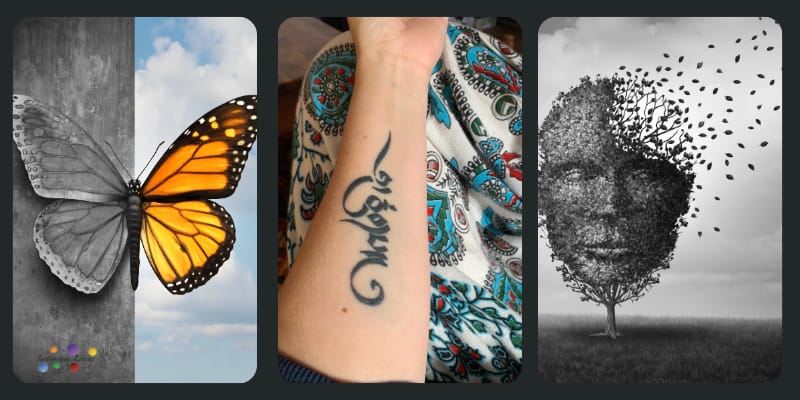
So, what did I do? I got a tattoo with ‘breath in Sanskrit on my forearm. Just so I can stop forgetting this basic action. In true, ‘the road less travelled’ fashion, I got Covid 3 days later… letting me practice its effectiveness from the word go.
A big part of life is about feeling understood. When we feel understood, it brings a sense of connectedness that helps us see the bigger picture. Perhaps releasing some of that much-needed oxytocin that helps us feel good.
Wow. This is a powerful piece. Thank you for putting so much time into sum Ritu good it. I especially love the John Roedel poem. It’s the kind of thing all of us should read each morning.
Thank you so much for taking the time to read it. John’s work is amazing. It’s difficult to choose my favourites.
Impressive peace of reading. Thank you for sharing. There are so many live lessons in this.
Baie dankie. 😊
Hey Michelle! There is a lot in here, thanks for the effort of putting it all down for us to read. I want to reflect on your idea about our instincts not being valid anymore? I think that we don’t honour our instincts enough actually, that we have lost our inner voices and that we don’t trust that non logical part of ourselves enough. But, the problem lies in reacting to, rather than acknowledging our instinct, observing it and then taking the time to reflect on how to placate that fear or whatever that is coming up. We live with so much noise in our lives and yet we need silence to have the opportunity to hear ourselves. We have an innate wisdom – you mention the gut – where do the instincts arise? It might be dangerous to reject any part of ourselves, including our instincts. I certainly don’t have the answers, I just know that I can’t ignore my instincts because when I do I get agitated and it causes me unhappiness, but if I take the time to listen to my inner voice, then I find the path again and I get back to being at peace. I agree that we cannot live in fear but for me that is what my instincts reveal – that which is not good for me – and I have to work out the what and the why etc. to put it to rest.
I hope this helps you a little, even if to only solidify your own truth, because, as you say, we are all different!
Take care xxx
What a great point Marcelle. I am making a distinction between gut and instinct and proposing a different look at instinct completely. I do like how you put it as honouring our instincts. It is about understanding what they are trying to tell us and work on the response. That is indeed where we have the power.