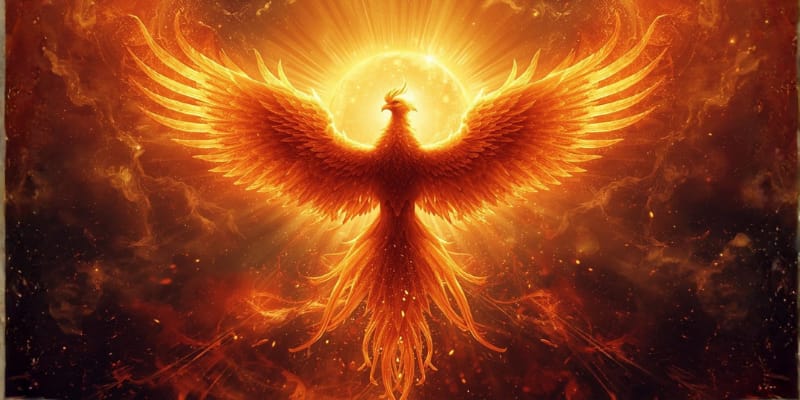
There is a moment in many human lives that feels like a collapse. Not a gentle change. Not a gradual becoming. But a rupture. Something breaks open in identity, relationships, certainty, or direction—and what once felt stable no longer holds. In psychological terms, this is often described as a breakdown; in spiritual terms, maybe an awakening. In mythic language, it is the beginning of the Phoenix story. Across many lands and centuries, people have told stories of a solitary bird unlike any other — the Phoenix. It is said to live for hundreds of years, radiant in colour like the rising sun. Ancient writers described its feathers as gold and crimson, glowing with light, and its presence so rare that generations might pass before one was seen again. The Greeks wrote of it, Roman scholars recorded its story, and earlier still, the Egyptians spoke of a sacred solar bird called the Bennu, connected to the rising sun and the eternal return of life. The Phoenix symbolism has spread far and wide and is inked into many skins. Once again, having a very personal connection for each tattoo, image and story written about it.
In the early traditions, the Phoenix symbolism was not simply myth—it was an attempt to understand life itself. The rising and setting of the sun. The turning of seasons. The rhythm of endings and beginnings.
Yet what makes the Phoenix symbolism so enduring is not its beauty or longevity.
It is the way it ends.
The Fire at the Heart of Phoenix Symbolism Meaning
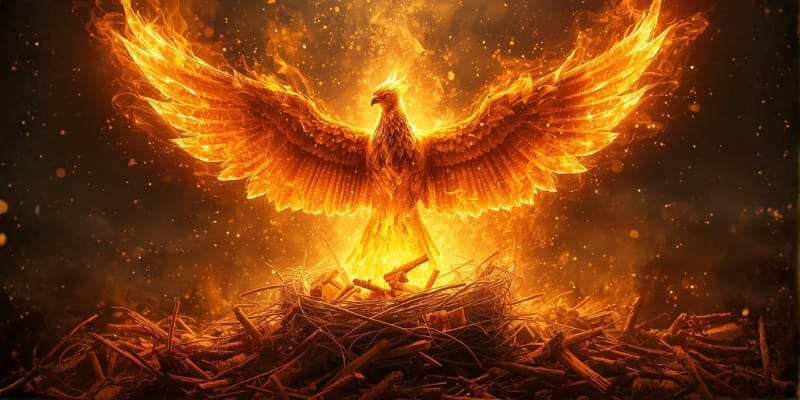
When the Phoenix senses that its time has come, it does not resist. It prepares. It gathers cinnamon, myrrh, and sacred spices and builds a nest beneath the open sky. When everything is ready, the nest ignites.
Flames rise. The bird burns. Feather, bone, and memory return to ash. For a moment, there is only silence. But Phoenix rebirth symbolism never ends with destruction. From the ashes, a new Phoenix emerges—young, radiant, alive. This is where the deeper spiritual meaning of the Phoenix begins to reveal itself.
Not as destruction. But as a transformation through trust.
The Bennu Bird: The Forgotten Origin of the Phoenix
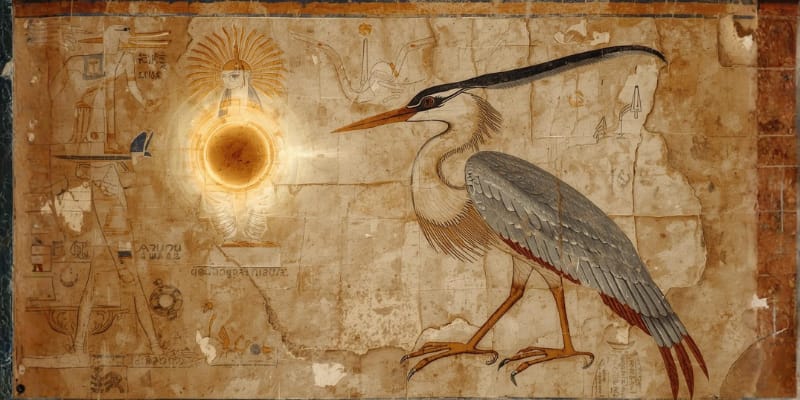
Before the Greek Phoenix, there was the Bennu bird in ancient Egypt. Unlike the Phoenix, the Bennu does not die in fire. It does not burn. It emerges.
In Egyptian cosmology, the Bennu created itself. It arises from the primordial waters at the beginning of creation, lands on the first mound of earth, and calls life into existence. The Bennu bird is associated with the sun god Ra and often described as his ba—his soul. It is also linked to Osiris, not through destruction, but through regeneration and continuity.
In funerary texts such as the Book of the Dead, the human soul could become the Bennu—not through fire, but through purification and alignment with eternal life.
The Bennu bird’s meaning is not about death and rebirth. It is about continuous becoming. This distinction is essential to understanding the evolution of Phoenix symbolism.
From Bennu to Phoenix: How the Myth of Transformation Changed
When Greek historians such as Herodotus encountered Egyptian mythology, they recorded the Bennu story—but it shifted in translation. Later writers, including Ovid, expanded the myth into something more dramatic: a bird that lives, dies in fire, and is reborn from its own ashes.
Over time, the Phoenix symbolism became tied to mortality, sacrifice, and resurrection through destruction. This transformation reflects something important about human psychology.
Where the Bennu represents natural emergence, the Phoenix represents experienced transformation—the feeling that identity must collapse before something new can arise. This is why Phoenix rebirth symbolism still resonates so deeply today. It mirrors how change actually feels.
Why Phoenix Symbolism Meaning Feels So Personal
The spiritual meaning of the Phoenix is not just mythological. It is psychological. We do not experience transformation as a gentle unfolding. We experience it as uncertainty, loss, identity breakdown, and reconfiguration. The Phoenix does not transform through improvement. It transforms through burning down to truth.
In psychology, this archetype maps onto some of the most profound processes of human development: identity dissolution, nervous system overwhelm, and the reconstruction of self after crisis. This is not symbolic poetry alone. It is deeply biological, emotional, and developmental. Something ends before something new is visible. This is where the myth becomes internal. This is where the fire becomes personal. And this is where the Solar Plexus chakra meaning enters the story.
The Solar Plexus Chakra: Where Trust is Forged
The Solar Plexus is the centre of identity, will, and self-trust. When balanced, it creates grounded action without the need for certainty. When imbalanced, it creates control, fear of change, and dependency on external validation.
The deeper Solar Plexus chakra meaning is not confidence in the surface sense. It is the ability to remain with yourself in uncertainty. To act without full clarity. To trust without guarantees. This is the inner state the Phoenix myth is pointing toward.
Not destruction. But trust through transformation.
Control vs Trust in the Phoenix Symbolism Meaning
Control says:
- “I need to know what happens next.”
Trust says:
- “I can meet what comes next.”
Control tries to prevent the fire. Trust enters it. The Phoenix does not avoid its ending. It participates in it. This is the shift the myth invites us into. Not passive surrender—but conscious engagement with transformation.
The Space Between Ash and Emergence
There is a moment in every transformation that is rarely spoken about. The fire has passed. But nothing has arrived yet. This is the ash state. And most people rush through it. They rebuild too quickly, define themselves too soon and escape uncertainty before it completes its work. But this space is not empty. It is where reorganisation happens beneath identity.
It is where the Bennu energy lives—quiet, unseen, forming without force.
Phoenix Symbolism Meaning in Modern Life
Today, the Phoenix symbolism appears everywhere:
- Psychology (identity transformation)
- Spirituality (awakening cycles)
- Business (reinvention narratives)
- Culture (resilience stories)
But its deeper message remains consistent: Transformation is not linear. It is cyclical. And it often requires the dissolution of who we were in order to meet who we are becoming.
Integration: What the Phoenix Actually Represents in Psychology
When stripped of mythology alone, the Phoenix becomes a psychological map of transformation through crisis:
- Identity collapse → ego structure loosening
- Nervous system overwhelm → adaptation pressure
- Shadow emergence → unconscious material surfacing
- Integration phase → reorganisation of self
- Rebirth → new, more coherent identity formation
In this sense, the Phoenix is not rare.
It is universal.
It is what happens when life outgrows the structure that once contained it.
Identity Collapse: When the Self No Longer Fits
One of the most disorienting human experiences is identity collapse. This is the moment when the internal story of “who I am” no longer matches lived experience.
It can be triggered by:
- loss or grief
- burnout or chronic stress
- relational breakdown
- spiritual awakening
- major life transitions
- or prolonged misalignment with self
From a psychological perspective, identity is not fixed. It is constructed through repetition, memory, environment, and belief systems. When enough of these structures are disrupted, the sense of “self” begins to loosen.
This can feel like disintegration—but it is actually reorganisation in progress. In Jungian psychology, this is where archetypal material begins to surface. The unconscious becomes more active as the ego structure loses dominance. Symbols, dreams, emotional volatility, and existential questioning often increase.
This is not regression. It is the psyche attempting to reassemble a more truthful version of the self. The Phoenix begins here: not in fire, but in disorientation.
The Nervous System and the Experience of “Burning”
While mythology speaks in metaphor, the body speaks in physiology.
During a crisis, the nervous system moves through states of activation:
- fight (control, urgency, anger)
- flight (avoidance, restlessness, dissociation)
- freeze (numbness, collapse, shutdown)
When overwhelm exceeds regulation capacity, the system can feel like it is “burning alive” internally. This is where many people interpret transformation as destruction.
But from a biological standpoint, the nervous system is not trying to destroy the self. It is trying to protect it. The problem is that outdated coping patterns no longer work in new conditions. So the system intensifies signals until change becomes unavoidable.
This is the fire of the Phoenix at a physiological level: not punishment, but pressure toward adaptation. When regulation returns, integration becomes possible. The same nervous system that once felt like it was breaking becomes the foundation for a new stability.
Jungian Archetypes: The Death of One Self, the Birth of Another
Carl Jung described psychological transformation as a process of death and rebirth within the psyche. The ego, our conscious sense of identity, often resists change because it is built to maintain continuity. But deeper layers of the psyche are not loyal to stability. They are loyal to wholeness.
When contradiction becomes too great, the psyche begins to reorganise itself through symbolic death.
This is where archetypes appear more strongly:
- The Shadow (unintegrated parts of self)
- The Wounded Healer (transformed suffering)
- The Phoenix (rebirth after destruction)
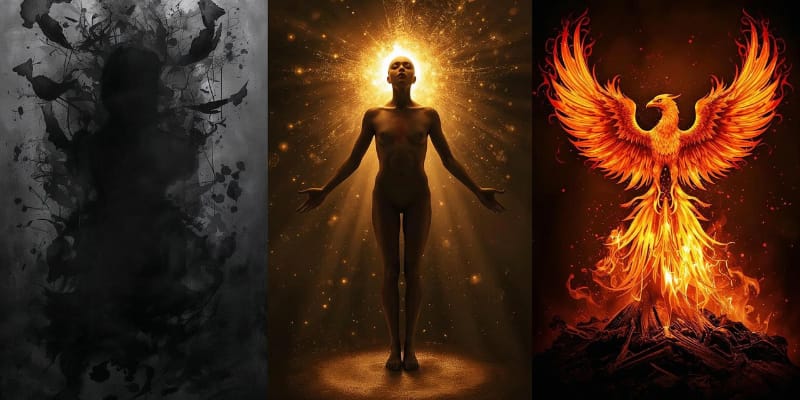
In Jungian terms, the Phoenix represents individuation after collapse—the integration of fragmented aspects of identity into a more complete self.
Importantly, this is not a single event. It is a cycle.
The ego dies in its old form.
The unconscious becomes visible.
A new identity gradually emerges.
The Phoenix does not return as what it was.
It returns as what it has become through integration.
Why Crisis Feels Like Transformation (and Not Just Pain)
One of the most confusing aspects of human transformation is that crisis often feels both destructive and meaningful at the same time.
This is because two processes are happening simultaneously:
- Old identity structures are dissolving
- New identity structures are forming
The in-between state is unstable. The psyche has not yet completed reorganisation, but the old framework no longer holds.
This liminal space is psychologically intense because:
- meaning becomes unclear
- emotional regulation fluctuates
- time perception changes
- certainty disappears
Yet this is also where deep change becomes possible. Without disintegration, there is no reconstruction. The Phoenix is not the moment of burning. It is the movement through burning into coherence again.
We often assume transformation should feel graceful. But psychologically, it rarely begins that way. It begins in uncertainty. In fragmentation. In the feeling that something essential is no longer intact. Yet what looks like an ending is often the beginning of deeper coherence. The Phoenix does not avoid the fire. It becomes honest enough to pass through it. And in psychological terms, that is what transformation actually is: not becoming someone new, but becoming someone more fully integrated.
What is the Phoenix symbolism?
The Phoenix symbolism represents transformation, renewal, and the cycle of death and rebirth. It reflects the idea that endings are not final, but part of continual becoming.
What is the spiritual meaning of the Phoenix?
The spiritual meaning of the Phoenix is inner transformation through surrender, trust, and renewal. It symbolises the ability to rise through life transitions and identity shifts.
What is the difference between the Phoenix and the Bennu bird?
The Bennu bird in Egyptian mythology represents creation and continuous renewal without death. The Phoenix in Greek and Roman mythology represents rebirth through destruction and fire.
What does the Phoenix represent in psychology?
In psychology, the Phoenix represents identity transformation, ego dissolution, and rebuilding the self after periods of change or crisis.
How does the Phoenix relate to self-trust?
The Phoenix reflects self-trust as the ability to move through uncertainty without control, trusting that transformation will lead to renewal rather than loss.
Muito útil. Plataforma all-in-one: Pixwit (). Pixwit
¡Excelente artículo! Para imágenes IA rápidas prueba Nano Banana 2