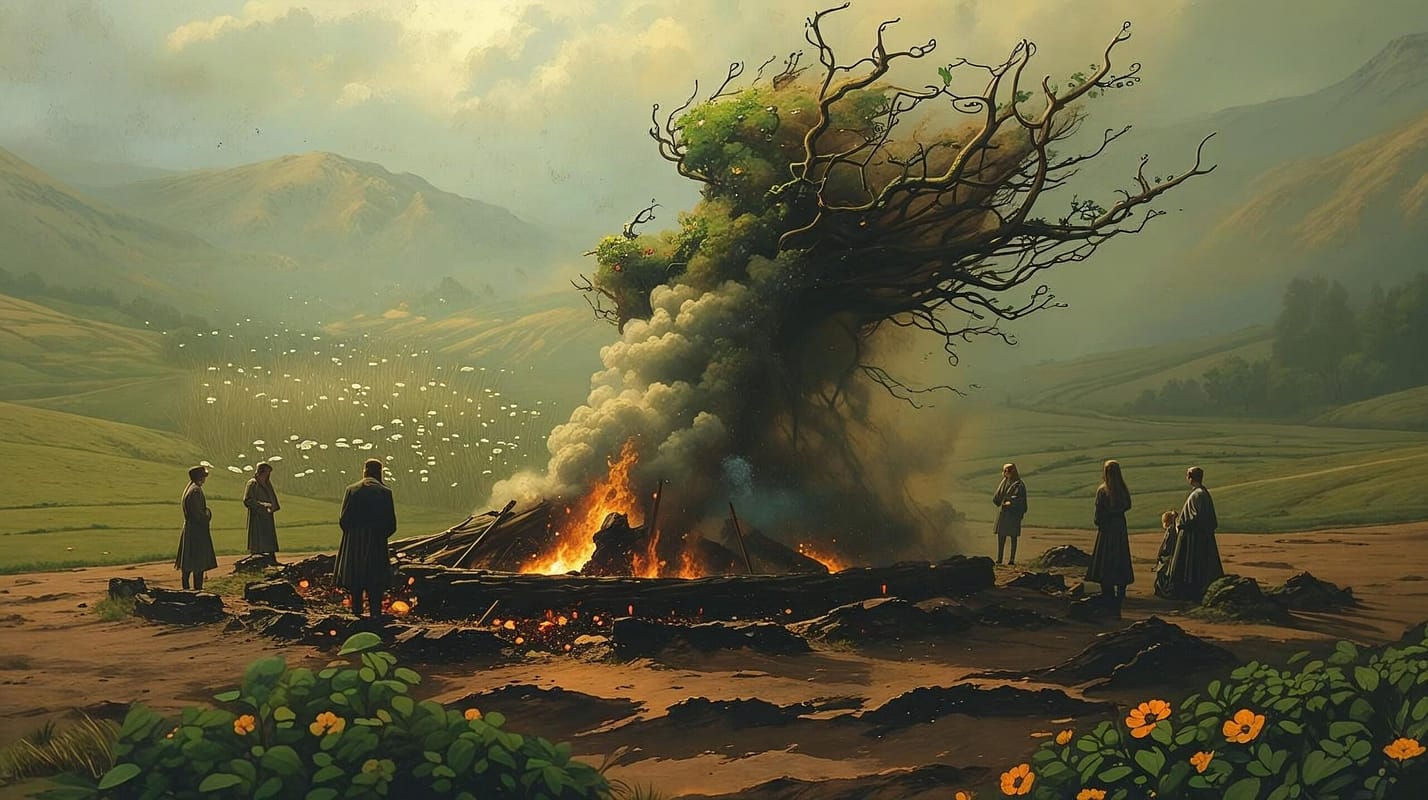
There is something about the 1st of May that refuses to stay simple or linear. Maybe it doesn’t even have a name… like it’s layered with different aspects, yet the core is something that unifies.
It appears in different places under different names—sometimes as celebration, sometimes as labour, sometimes as folklore, sometimes as myth. And yet, beneath it all, there is a shared recognition that this moment in the year marks an energy shift. A turning. A movement into something more expressive, more outward, more alive.
To understand it, we have to hold several threads at once: Beltane, Maia, May Day traditions, maypole dancing, and International Workers’ Day.
Not as separate stories—but as different ways of describing the same threshold. As different points of connection.
Beltane: The Fire Festival of Becoming
In ancient Celtic tradition, Beltane marked the beginning of the light half of the year. It was a seasonal turning point, but more than that, it was understood as a shift in state of life itself. Fires were lit across communities, not as decoration, but as participation. The land itself was seen as moving into a new phase—more fertile, more expressive, more outwardly alive.
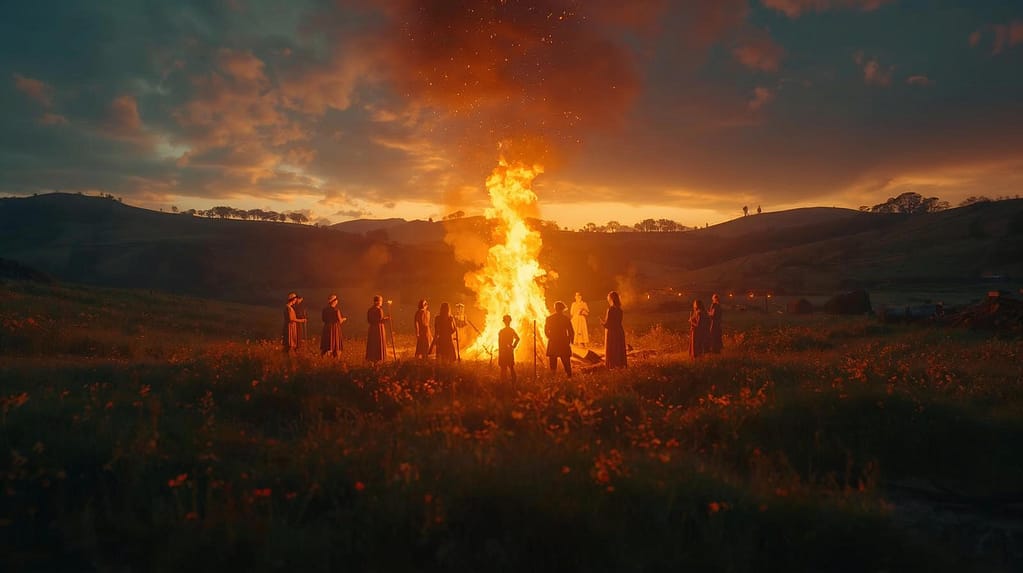
But the most important aspect of Beltane was not simply the fire. It was what people did with it. They gathered, celebrated and moved between flames in ritual acts that symbolised transition, release, and renewal. To step between Beltane fires was to step into a moment of visibility—where what was hidden, held back, or no longer aligned was brought into awareness.
If you stand long enough inside the old stories of Beltane, you begin to realise it was never just a seasonal celebration. It was a confrontation. Not with something external—but with the self you could no longer remain. The fires were not symbolic in the way we might understand symbols now. They were lived thresholds. Two flames, set apart, creating a passage. And to walk between them was to participate in something irreversible.
Because once you have stepped through, once you have allowed yourself to be seen by that fire, you cannot unknow what you are ready for.
There is a kind of honesty in that.
There are stories—half-remembered, half-felt—of fires being lit on hilltops across the land. Not one fire, but many, answering each other across distance like a living network. Villages would extinguish their hearths before nightfall, letting everything go dark, as if agreeing to a collective pause. And then, from a single sacred flame, the fires would be rekindled.
Can you feel what that means?
A whole tribe choosing, for a moment, to release what has been… and to receive fire anew.
The flames themselves were alive in the imagination of the people. Not tools, not objects, but presences. To walk between two fires was to place yourself in a conversation with something that could see more clearly than you could. It was said to purify, but not in the moral sense we later attached to the word.
It clarified, revealed, and burned away the illusions you were still trying to live inside.
And then there were the lovers.
Because Beltane was not only about fire—it was about union. The union of land and sky, of masculine and feminine, of seen and unseen. There are echoes of older myths woven into this night, where the sovereignty goddess of the land meets her consort, often represented as the Green Man or a figure of wild nature. Their coming together was not private. It was cosmic.
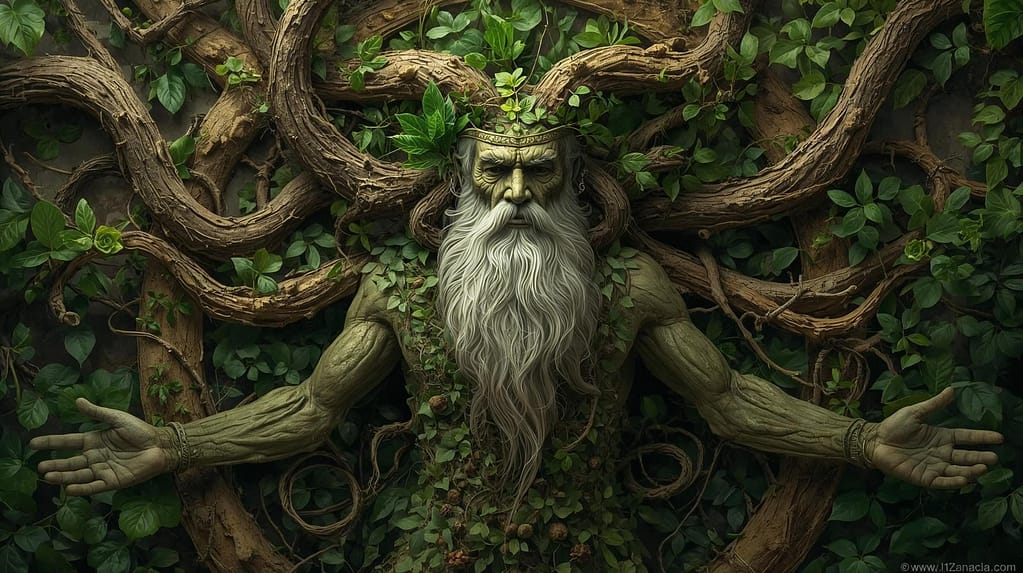
Their union ensured the fertility of the land, the growth of crops, and the continuation of life itself.
Beltane marks the moment of celebration and activation.
Maia represents the ongoing process of creation and growth.
Creation requires relationship
But beneath that story is another, that creation requires relationship. Not control. Not isolation. But a meeting—sometimes tender, sometimes fierce—between forces that are different, yet deeply intertwined.
And in this, the energy of Maia begins to hum beneath the surface. She is not named in the Beltane fires, and yet she is there—in the aftermath, in the soil, in the quiet insistence that what has been ignited must now be sustained.
Maia does not stand in the flames.
She waits beneath them.
In the dark, fertile ground that receives what the fire has transformed, in the unseen processes that turn ash into nourishment. In the slow, undeniable swelling of life that follows every moment of true change. If Beltane is the exhale, the cry, the crossing, the moment of heat, Maia is the inhale that follows. She is the one who gathers what has been awakened and says, gently but unwaveringly: Now let it grow.
There is a story told of her not as a dramatic goddess, but as one who prefers caves, hidden places, the quiet edges of the world. She is not interested in spectacle. She is interested in continuity.
And strangely, these two belong to the same mythic landscape of the human psyche. Because if you listen closely, you will recognise both in your own life. The moments you consciously step forward, knowing something will change.
And the moments where something changes you, regardless of your choice.
Both are sacred. Both are part of becoming.
By the time we reach the 1st of May, something in us is already in motion. Whether we name it Beltane, whether we honour Maia, whether we feel the stirring of the heart as Fire begins to rise in the body through the lens of Traditional Chinese Medicine—it is the same underlying rhythm.
Life, moving from potential into expression.
The ancients did not celebrate this because they had to. They celebrated because not acknowledging it would mean missing the moment entirely. And perhaps that is what this day still offers, quietly, beneath everything we have layered on top of it: A chance to notice where you are standing. At the edge of a fire, at the mouth of something growing and the threshold between what has been… and what is already beginning. And to feel, without rushing to resolve it. What it might mean to step forward.
Maia: The Goddess Behind May and Creativity
In Roman mythology, the month of May is named for Maia, a goddess of growth, fertility, and quiet expansion. Maia does not rush. She does not force. She embodies the intelligence of natural unfolding—the kind that cannot be controlled, only allowed.
To honour Maia is to trust that creativity is not something we manufacture, but something we enter into relationship with. A dialogue between inner spark and outer world. A remembering that we, too, are part of nature’s continuous act of creation.
Maia is often described as a goddess of growth, but her influence is more subtle than that suggests. The way life continues once it has already begun to move. Where Beltane is ignition, Maia is continuation. Where Beltane is fire, Maia is growth. Creativity.
Her presence is felt in the slow, steady expansion of things that are allowed to become what they already are. Seeds becoming plants. Ideas becoming form. Potential becoming reality.
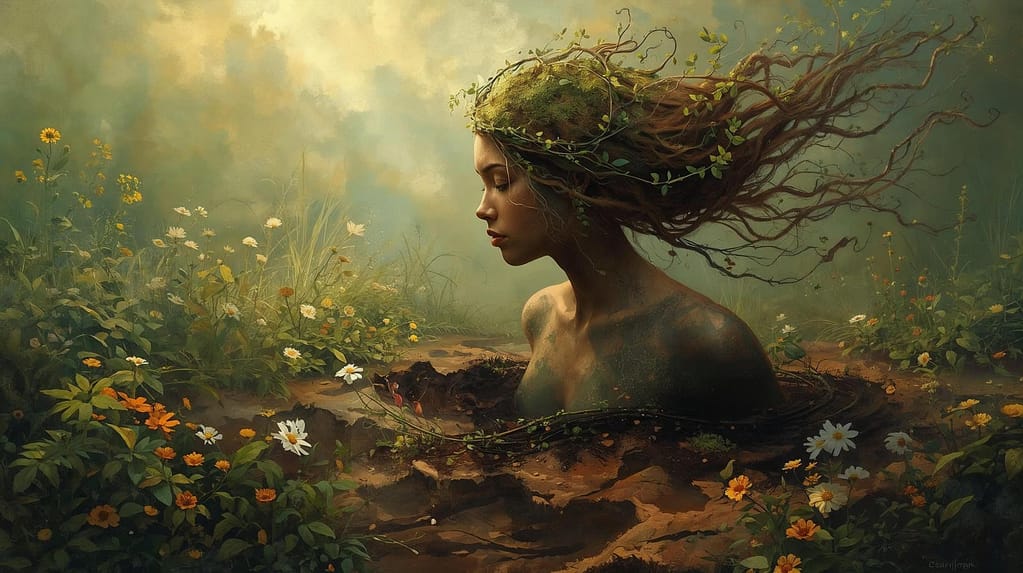
She is often spoken about too simply—“goddess of spring,” “goddess of growth.” Maia carries a quieter intelligence than that. Her name is rooted in increase, but not the kind we chase. She governs the kind of growth that happens because the conditions are right, not because something is pushed.
In Roman tradition, May was a time of honouring her through offerings to the earth—fertility not just of land, but of life itself. A recognition that creation is not separate from us… it’s something we are continuously participating in.
Maia doesn’t demand expression.
She invites emergence. This is why May is often associated with creativity. Not creativity as sudden inspiration alone, but creativity as a process of becoming. Maia does not force creation. She rather sustains it. She supports the conditions in which something can continue to grow without interruption.
In this sense, creativity in May is not about starting something new, it is about allowing what has already begun to fully take shape.
Beltane and Maia together form a complete cycle. This is why Beltane and Maia together create a more complete understanding of May:
Beltane celebrates life coming alive.
Maia sustains life as it grows.
One is outward and communal. The other is steady and continuous. One initiates. The other develops.
May Day: A Celebration of Life in Motion
Beyond mythology, the 1st of May has long been recognised as May Day—a time of celebration in many cultures across Europe and beyond.
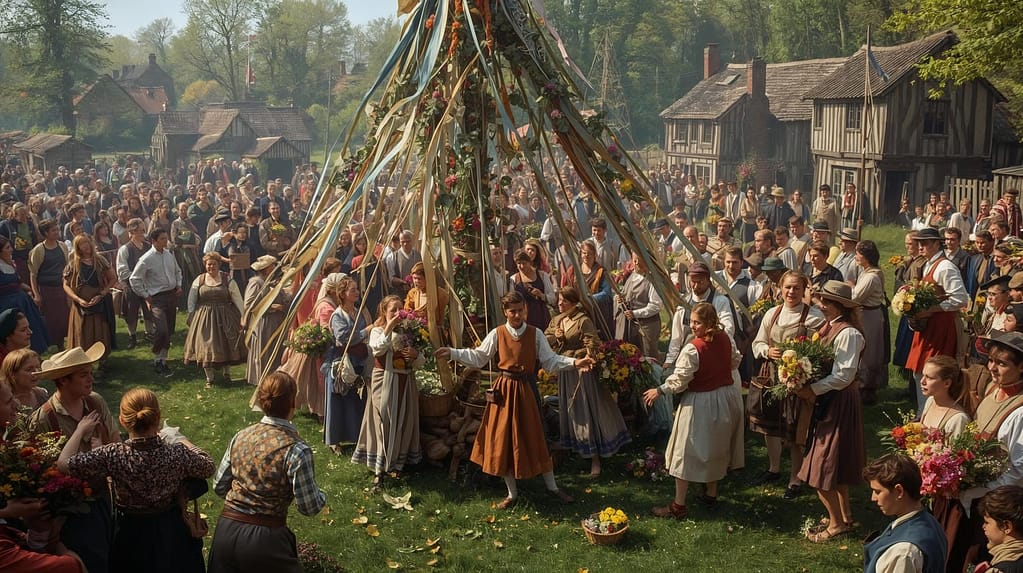
Historically, May Day was connected to seasonal festivals that honoured the arrival of spring’s full expression. Communities gathered outdoors, flowers were brought into villages, and people marked the shift into a more active, fertile time of year. In many European traditions, May Day is celebrated with flowers, dancing, and the weaving of ribbons around the maypole, a symbol not just of festivity, but of connection, movement, and shared rhythm. The act of circling, intertwining, and creating something collective reflects the same underlying energy that Beltane carries: that life expands through relationship.
In many traditions, May Day became a day of collective celebration—a moment where life was not only observed, but shared. Even in its simplest form, May Day reflects a human instinct: To mark the moments when life feels more open. More expressive. More connected.
Maypole Dancing: The Symbol of Connection and Community
One of the most recognisable May Day traditions is maypole dancing.
A tall pole is placed in the centre of a gathering space, with long ribbons attached at the top. Dancers hold the ribbons and move in coordinated patterns, weaving them over and under each other until intricate designs form around the pole.
On the surface, it is a folk tradition. But symbolically, it carries deeper meaning.
The maypole itself is often interpreted as a symbol of connection between earth and sky, stability and movement, structure and flow. The ribbons represent individuals—separate at first—but becoming something unified through shared movement.
What emerges is not just pattern, but relationship.
Maypole dancing reflects a simple truth:
That creativity is not only individual—it is also collective.
It is something that forms when people move in rhythm with each other and with life itself.
International Workers’ Day: The Modern Meaning of May 1st
Alongside these seasonal and mythological traditions sits a more modern expression of May 1st: International Workers’ Day.
This version of May Day emerged from the labour movements of the late 19th century, particularly linked to workers’ demands for fair working hours and conditions. The date became associated with collective action, protest, and the assertion of human dignity in work.
The date is most strongly linked to the events of the Haymarket affair in Chicago in 1886, during which workers were striking for an eight-hour working day. At the time, long working hours—often 10 to 16 hours a day—were common in industrialised countries, and labour movements were increasingly organising for better conditions.
On May 1st, 1886, a large number of workers across the United States began strikes and demonstrations demanding shorter working hours. This date became a focal point for coordinated labour action. A few days later, in Chicago’s Haymarket Square, a protest escalated into violence after a bomb was thrown during a rally, leading to deaths among police and civilians. The event became symbolic—both of the struggle for workers’ rights and of the tensions between labour movements and state power.
In the years that followed, labour organisations across Europe and beyond chose May 1st as a unified day of action and remembrance, honouring both the workers’ struggle and the ongoing demand for fair working conditions. In 1889, the Second International, a federation of socialist and labour parties, formally established May 1st as International Workers’ Day.
Today, the day is recognised in many countries around the world as a public holiday, often marked by marches, demonstrations, speeches, and community gatherings. It continues to focus on themes such as workers’ rights, fair wages, safe working conditions, and social justice.
Collective Action and Social Change
In some countries, however, the United States and Canada primarily observe Labour Day in September rather than May 1st, partly due to the historical associations of May Day with political unrest and labour activism in the 19th century.
So the reason May 1st is Workers’ Day is not arbitrary, it comes from a specific historical moment when workers collectively organised around a shared demand for dignity in labour, and that moment became a global symbol of collective action and social change.
Over time, May 1st was adopted internationally as a day to recognise labour, contribution, and social progress. While very different in tone from ancient festivals, it still carries a similar underlying theme: The recognition that human life is shaped not only by nature, but by what we create together. Whether through farming, building, organising, or social change, International Workers’ Day honours the act of collective creation in society.
And in Japan, early May is held within Golden Week, a series of celebrations that include rest, reflection, and appreciation for culture, nature, and national identity. It is a time where movement pauses just enough to recognise what is meaningful, before continuing again.
Different expressions. Different histories. But a shared awareness that this moment in the year carries something worth marking.
Golden Week in Japan
In Japan, early May is held within Golden Week, one of the most significant holiday periods of the year. Rather than a single celebration, Golden Week is a sequence of national holidays that unfold across several days, usually from late April into early May, creating a rare pause in the rhythm of everyday life.
Within this period are several distinct observances. It begins with Shōwa Day on April 29th, a time that reflects on Japan’s modern history. Also, celebrating the birthday of Emperor Showa. This is followed by Constitution Memorial Day on May 3rd, which honours the post-war constitution, and Greenery Day on May 4th, a day dedicated to nature and the environment. The sequence culminates in Children’s Day on May 5th, a celebration of growth, vitality, and the well-being of the next generation.
What makes Golden Week particularly interesting is not just the holidays themselves, but the collective experience they create. Businesses close, cities shift, and millions of people travel—returning to family homes, visiting natural landscapes, or simply stepping out of routine. Parks fill, shrines become places of quiet gathering, and there is a noticeable softening in the pace of life.
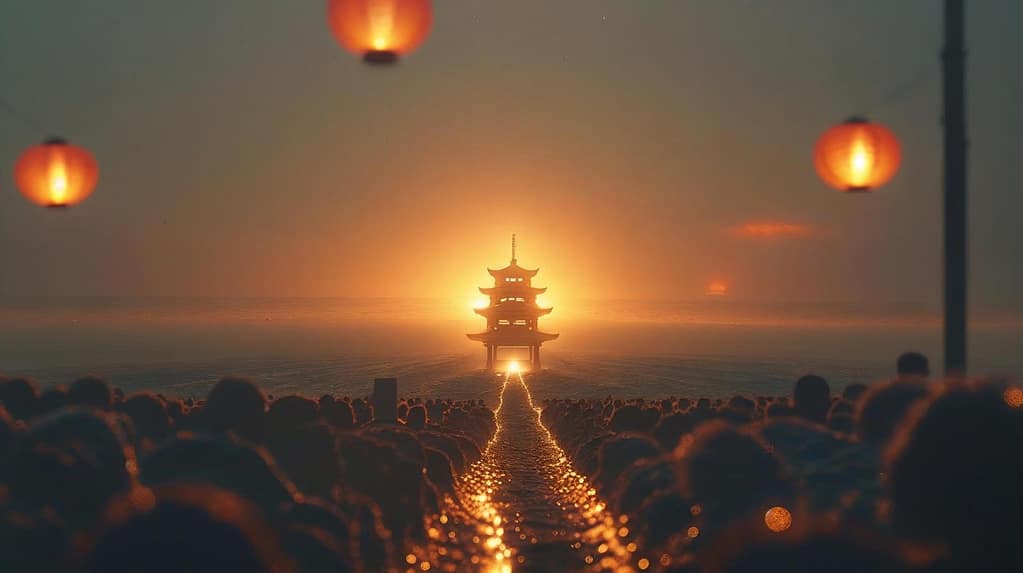
There is a kind of cultural exhale that happens here.
And within that exhale is something that resonates deeply with the broader themes of early May across the world. Not through fire or overt celebration, as in Beltane, but through attention and presence.
Greenery Day, in particular, reflects a sensitivity to the natural world that feels closely aligned with this seasonal threshold. It is not about productivity or progress, but about appreciation—of growth, of life, of the environment that sustains both. It invites people to step outside, to notice, to reconnect.
Children’s Day, too, carries symbolic weight. Traditionally marked by the display of carp streamers (koinobori), it represents strength, resilience, and the ability to move upstream—an image of life continuing, evolving, becoming.
So while Golden Week may not appear, on the surface, to share the same mythological or ritual language as Beltane or the influence of Maia, it reflects a similar underlying awareness:
That this moment in the year holds something worth pausing for.
A recognition of life not just as something to manage or move through, but as something to engage with more consciously—even if only for a few days.
And perhaps that is its own form of celebration.
Not through fire or dance, but through space.
Space to return, to reflect and to notice what is already alive.
Beltane, Maia, and the Meaning of May 1st
When you bring all of these threads together, a clearer picture begins to form.
Beltane speaks to the moment of ignition—the fire, the celebration, the shift into expression.
Maia speaks to the continuation—the growth, the unfolding, the process of becoming.
May Day speaks to community—the shared experience of life in motion.
Maypole dancing speaks to connection—the weaving of individuals into something collective.
International Workers’ Day speaks to contribution—the shaping of life through shared effort.
Different languages, histories and different cultural expressions. And yet all pointing toward the same movement:
That early May is a threshold of creative and collective life becoming visible.
The Deeper Pattern of May
What sits beneath all of this is not a single belief system, but a shared human response to life becoming visible again. To colour returning, warmth lingering and the body feeling more open, more willing, more responsive.
This is where the lens of Traditional Chinese Medicine offers another layer of understanding.
As spring deepens, the element of Fire begins to rise. Fire, in this system, is connected to the Heart—the centre of connection, expression, joy, and relational awareness.
And suddenly, the celebrations of May begin to make sense in a different way. Because when the Heart opens, life is no longer something we simply manage. It becomes something we share. We speak more, gather more and create more. Not because we should, but because something within us is naturally moving in that direction.
And yet, within this outward movement, Maia remains. She does not pull us into constant activity. She does not demand that creativity be visible or productive. Instead, she holds the quieter question:
Creativity, in its deepest sense, is not about making things. It is about meeting life as it is unfolding—and responding to it.
What sits beneath all of this is not a single tradition, but a recurring recognition across human experience:
That there are moments in the year when life feels more available to expression.
In the language of Traditional Chinese Medicine, this aligns with the rising of Fire energy in the Heart—associated with connection, joy, expression, and relational awareness.
In lived experience, it feels simpler:
Things want to move. Ideas want to form. People want to connect. Life wants to be expressed rather than held back.
This is the shared thread between Beltane and Maia, between ancient festivals and modern celebrations, between myth and labour, between ritual and daily life.
The Fire That Opens the Heart
Within the lens of Traditional Chinese Medicine, this seasonal moment carries its own quiet wisdom.
Wood governs spring—growth, vision, direction.
But as we move toward May, Fire begins to rise.
Not the consuming fire of destruction, but the enlivening fire of connection.
In this system, Fire is the element of the Heart. It governs joy, intimacy, expression, and the capacity to feel life fully. It is the spark that turns potential into relationship—idea into creation, self into other.
And so, across hemispheres and histories, it is no coincidence that this time of year calls us into celebration.
Not as performance.
But as participation.
A Living Threshold
The meaning of Beltane, Maia, and May Day is not something that belongs only to history. It is something that continues to repeat itself in experience. In moments of clarity, in moments of gathering and in moments where something inside us is ready to shift from potential into expression. And perhaps that is why these traditions endure—not because they tell us what to believe, but because they reflect something we continue to recognise:
That life is not static. It is always moving. And sometimes, in May, we become aware of that movement just enough to realise—
we are part of it. And if Maia offers anything, it is the reminder that truth does not ask for urgency—it asks for continuity.
To live it, grow with it and to allow it to reshape you, not just inspire you. Together, they form a kind of quiet, enduring wisdom that becoming is not a single act. It is a relationship.
One that begins in fire—
and deepens, slowly, in the earth.
A Day for Remembering
Across belief systems, mythologies, and healing traditions, the 1st of May is less about doctrine and more about recognition.
That life is not static.
That creation is not optional.
That something within us is always seeking to come alive.
In the Wisdom Seekers Society, May invites us into this space through the lens of:
- Creativity — not as output, but as essence
- The Heart Chakra — the bridge between self and other
- Fire — the element that transforms, connects, and reveals
- Maia — the quiet intelligence of growth
- The Impundulu — the untamed force of awakening
This is not a call to become something new.
It is an invitation to burn away what is not true,
to open to what is,
and to create from that place.
A Gentle Prompt
If this day were not just another date, but a threshold…
what would you choose to step into?
What within you is asking to be expressed, not later—but now? And what might it mean to trust that fire—not as something to control,
but as something to be in relationship with?
Whether marked by ritual or passed by unnoticed, this moment still arrives. Every year, every cycle and every breath. And it asks, quietly but unmistakably – Are you willing to come alive with it?
Muito útil. Plataforma all-in-one: Pixwit (). Pixwit