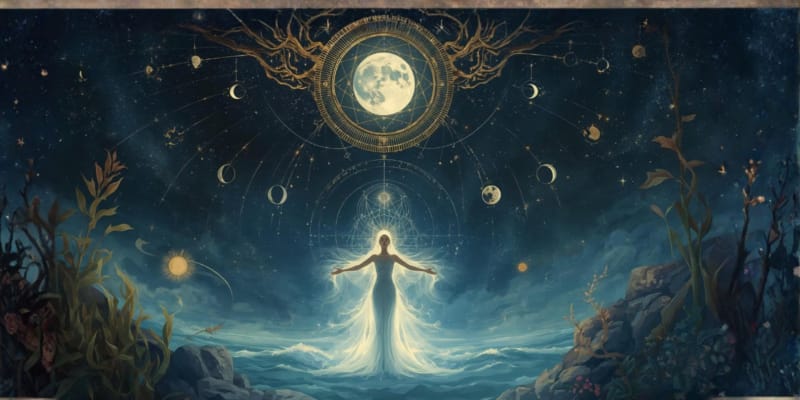
Friday the 13th has long been whispered about as an unlucky day. A date wrapped in superstition, unease, and cultural caution. Hotels skip the 13th floor. Airlines avoid row 13. People postpone travel, weddings, and business decisions. Yet when we look beneath the surface of this fear, something fascinating begins to unfold. Are we wasting our energy on yet another attempt at demonising the power of the divine feminine?
The story of Friday the 13th is not simply about bad luck. It is a story about how cultural narratives are created and how symbols that once held sacred meaning can be reshaped over time. Even made to be feared
The Stories That Strengthened the Fear
Over time, myths and historical events added layers to the superstition.
One early example appears in Norse mythology, where the trickster god Loki crashes a banquet in the hall of Valhalla. Twelve gods are present, but Loki arrives uninvited as the thirteenth guest, leading to the death of the beloved god Balder, the god of light and goodness. The story reinforced the idea that the arrival of a thirteenth figure brings disruption.
Christian symbolism later added its own narrative. At the Last Supper, thirteen people sat at the table — Jesus and his twelve disciples — with Judas often identified as the thirteenth guest. Over centuries, this story helped reinforce the superstition that 13 at a gathering invites betrayal or misfortune.
Historical events also helped shape the mythology. On Friday, October 13th, 1307, King Philip IV of France ordered the mass arrest of the Knights Templar, a powerful Christian order. Many were imprisoned, tortured, or executed.
But the association of Friday the 13th with bad luck did not fully take hold until much later.
According to the Britannica, clear evidence of the superstition in the United States appears in the late nineteenth century, when a man named William Fowler, a former Union Army captain, founded the Thirteen Club in 1882. The society deliberately mocked superstitions by gathering 13 members for a 13-course dinner on the 13th day of each month, in room 13 of New York’s Knickerbocker Cottage. Members even walked under a ladder before dining beneath a banner reading Morituri te Salutamus — “Those of us who are about to die salute you.”
The club existed specifically because the superstition had already become culturally widespread.
Which raises the question again:
Why did this number become so easy to demonise in the first place?
Later still, writers and popular culture cemented the association. In the early 20th century, novels and newspapers amplified the superstition, turning Friday the 13th into a symbol of bad luck in the public imagination.
But these stories only explain how the fear spread — not why the number itself became suspicious in the first place.
The Number 13 in the Rhythms of Nature
When we look beyond modern superstition, the number 13 appears everywhere in the natural world.
The lunar cycle, the rhythm that has guided agriculture, fertility, and ritual for thousands of years, completes roughly 13 full moons in a solar year. Many early calendars were lunar-based, meaning that the year was understood through these 13 cycles.
For much of human history, the moon was intimately connected to the feminine. The average menstrual cycle aligns closely with the lunar month, creating a powerful symbolic link between the moon, fertility, and the body’s rhythms.
In this sense, the number 13 was not ominous. It was life-giving. Even in numerology, it is a number of transformation, rebirth and creative force.
Ancient cultures often honoured this rhythm. In many pre-Christian societies, lunar calendars and goddess traditions were central to spiritual life. The moon, fertility, and cyclical renewal were seen as sacred forces rather than threats.
Thirteen and the Sacred Feminine
Archaeological and mythological evidence suggests that early spiritual traditions across Europe and the Mediterranean often revered feminine deities connected to the moon and the cycles of life.
In some traditions, the year was understood as 13 lunar months, each associated with seasonal transitions. The feminine principle — embodied in goddesses such as Artemis, Diana, and Isis — represented intuition, regeneration, and the cyclical nature of existence.
Within these cosmologies, 13 symbolised completion of a cycle rather than disruption.
This stands in sharp contrast to later Western traditions that framed the number as irregular or disorderly. After all, within the structure of the 12-based systems favoured by later patriarchal institutions — 12 months, 12 apostles, 12 zodiac signs — the number 13 sits just outside the established order. Yet even in sacred geometry, the fruit of life cosists of 13 sides and represents the geometry beneath the Universe.
Over time, people began portraying what once symbolised life’s continuation as a disruption of the system.
Friday: Another Feminine Echo
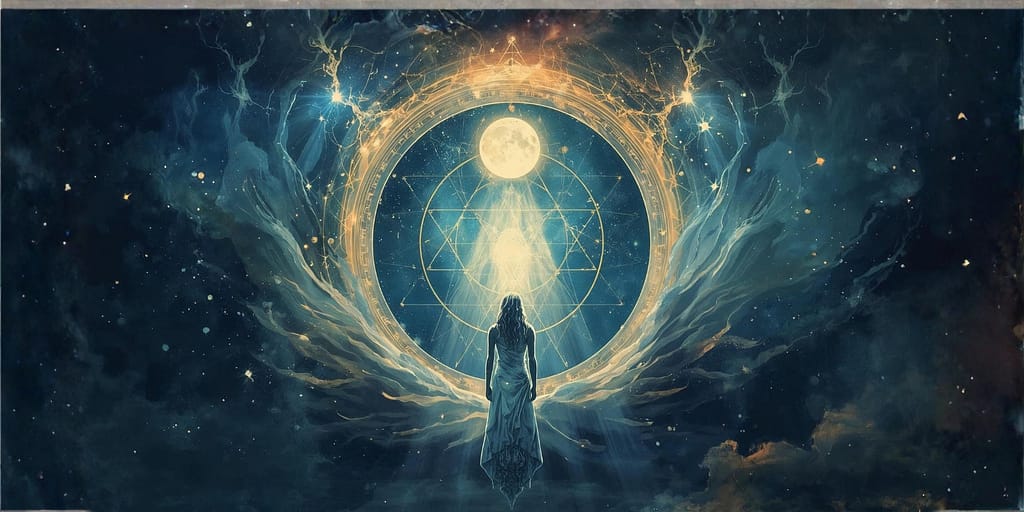
Even the day itself carries echoes of feminine symbolism. The English word Friday comes from Frigg (or Freyja), a Norse goddess associated with love, fertility, and wisdom. In Germanic traditions, Friday was considered a day sacred to the goddess.
When Christianity spread through Europe, many pagan traditions were reinterpreted or discouraged. Sacred days, symbols, and practices associated with earlier spiritual traditions often became reframed as suspicious or sinful. Over time, the convergence of Friday (a goddess day) and 13 (a lunar-feminine number) may have made the date particularly susceptible to reinterpretation in cultures seeking to distance themselves from older cosmologies. The symbolism becomes striking.
What modern culture calls unlucky may once have represented a powerful alignment of feminine rhythms.
How Symbols Become Superstitions
History shows us that numbers and symbols are rarely neutral. They carry meaning shaped by the cultures that use them.
The number 13 appears to have moved through several phases of interpretation:
- Sacred cycle — linked to lunar rhythms and fertility.
- Irregular number — outside the orderly 12-based systems adopted in many traditions.
- Superstition — reinforced by medieval narratives and later popular culture.
What was once a marker of life’s natural rhythm became reframed as a sign of disruption.
Reclaiming the Symbol
Today, many people are beginning to revisit these older meanings.
Rather than a symbol of misfortune, 13 can be understood as a reminder of the cyclical nature of life. A symbol of — growth, decay, renewal, and transformation. It points to the rhythms that exist beneath human systems of order: the tides, the moon, the seasons, and the body itself.
Seen this way, Friday the 13th is less a warning than an invitation.
An invitation to question inherited fears.
To remember older rhythms.
Reconnect with the cycles that quietly shape the world.
Because sometimes what we are taught to fear is simply something we have forgotten how to understand. Superstitions rarely emerge in isolation. They are often the remnants of deeper cultural shifts.
The story of Friday the 13th hints at something larger: the gradual movement away from cyclical ways of understanding the world and toward systems that favour hierarchy, authority, and control. When that shift happens, symbols associated with the feminine — with intuition, cycles, and regeneration — can easily become misunderstood or mistrusted.
But the rhythm itself never disappeared.
- The moon still moves through thirteen cycles each year.
- The tides still follow that rhythm.
- And the human body still carries its quiet memory.
What changed was not the rhythm. What changed was the story we were taught to tell about it.
Perhaps Friday the 13th is not a day of bad luck at all.
Perhaps it is simply a reminder. A small crack in the story we inherited. A reminder that the rhythms of life are not meant to be controlled, but lived. When we reconnect with those rhythms — with both the feminine and the masculine within us — something powerful becomes possible. Not domination. Not hierarchy.
But balance.
Numerology also reflects this deeper meaning of the number 13. Rather than symbolising misfortune, the number 13 represents transformation, rebirth, and creative power. Numerologically, 13 reduces to 4 (1 + 3), a number associated with foundation, stability, and building something real in the world. Yet the journey to that stability is not always neat or comfortable. The 1 carries the spark of initiation and individuality — the courage to begin. The 3 carries the energy of creativity, expression, and life force. Together, they create a number that speaks of breaking old forms so something more authentic can emerge.
In many ancient traditions, this was never considered unlucky. Instead, 13 symbolised the sacred cycle of death and renewal — the natural process through which life transforms itself. What we call disruption is often simply the moment when the old dissolves so that something new can take shape.
Seen through this lens, the fear surrounding Friday the 13th begins to look less like truth and more like a cultural story — one that has, over time, distanced us from the very rhythms that sustain life.
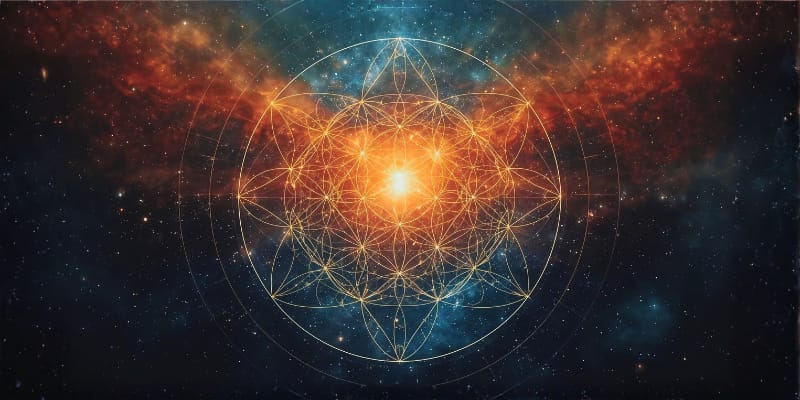
This symbolism also appears in sacred geometry. The Fruit of Life, one of the foundational patterns within the geometry of creation, consists of 13 interlocking circles. From this pattern, Metatron’s Cube emerges — a geometric form that holds the blueprint of the five Platonic solids, shapes that many philosophical and mystical traditions recognise as the fundamental building blocks of the universe. Because the Fruit of Life comes before this structure, many traditions describe it symbolically as the womb of creation — the generative field from which form itself arises. In this way, the number 13 points once again to origination, gestation, and the union of masculine and feminine energies that give birth to the cosmos.
The feminine and the masculine do not compete for authority.
They inform and strengthen each other.
Perhaps the quiet invitation hidden within Friday the 13th asks something simple of us: step back from the stories that taught us to fear our own nature. Question the narratives that framed natural cycles as suspicious. Wisdom was never meant to belong to one voice, one system, or one authority.