There are some trees you admire, and then there are trees that recognise you. Trees that remind you of a world that you knew even better than this one. The Baobab is not a tree I “study.” It is one I feel.
In this season of our Remembering when We Were Trees series, I love rekindling and deepening my connection to these stories.
For me however, the Baobab is different.
It is heat.
Dust.
It is red soil and silence.
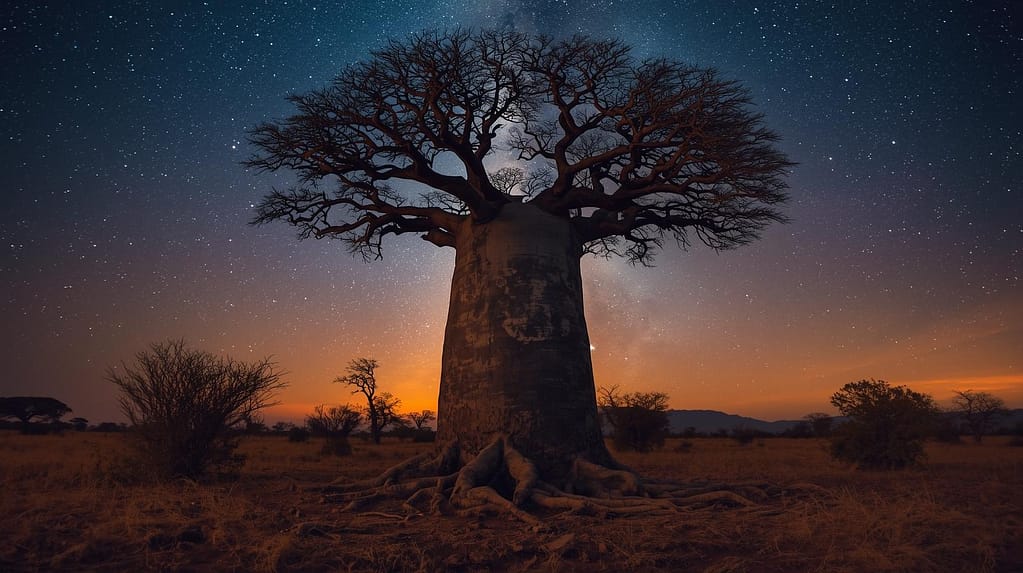
The Baobab does not stretch dramatically toward heaven. It widens, thickens and stores. The African baobab — Adansonia digitata — can live for over a thousand years. Some are estimated to be closer to three. Imagine the empires that have risen and fallen in that time. Imagine the migrations. The borders. The erasures. The stars.
And still, it stands. That, to me, is the wisdom of the Baobab.
The Story of the Upside-Down Tree
There is a story told across different parts of Africa about why the Baobab looks the way it does.
It once grew beside water, where it noticed the elegant palm. It watched the flame tree burst into red blossoms like fire against the sky. Saw fig trees heavy with fruit. And then one day, it saw its own reflection. Its trunk was swollen, bark rough, and flowers were pale and fleeting. It did not resemble the others.
It wondered why.
In some versions of the story, it questions the Creator. In others, it simply murmurs into the wind. But the heart of the myth remains the same: its orientation shifts. For its judgment of itself, it loses its footing. It gets uprooted and thrown back to the earth. However it lands back in the earth upside-down. Its branches begin to resemble roots reaching upward into the sky.
I do not hear this as punishment. I hear it as reorientation. The Baobab could no longer rely on reflection to understand itself. It had to discover its purpose through relationship — to land, to drought, to people. And perhaps this is where the wisdom of the Baobab becomes personal.
How often do we look into cultural mirrors and decide we are not shaped correctly? How often do we compare our pace, our body, our path, our expression — and feel upside-down?
The Baobab’s answer is simple.
Root deeper. Hold more.
Adaptation Is Sacred
Biologically, the Baobab is a master of adaptation.
In dry climates, it stores thousands of litres of water in its trunk. It sheds its leaves in the dry season to conserve energy. Its bark regenerates after damage. It flowers at night — pale, luminous blossoms opening in the dark, pollinated by bats while the world sleeps.
Nothing about it is rushed. Nothing about it is performative. Its beauty is not designed for applause. It survives because it prepares. This is the deeper wisdom of the Baobab.
Similarly, the Foundation of Self is not about appearing strong. It is about becoming resourced. Grounded.
This month, aligned with Water and the Root Chakra, we are not speaking about emotion as drama. We are speaking about stored wisdom. About the emotional resilience you carry because you have already lived through droughts — literal or metaphorical.
Water in the Baobab is not spilt. It is held.
Upside-Down as Initiation
There have been seasons in my life where I have felt inverted. Living between continents. Between identities. Between stories of who I was and who I am becoming. Upside-down can feel like exile. But what if it is initiation? The Baobab’s branches resemble roots reaching into the sky. Its unseen roots sink deep into the soil. It is fed from both directions.
Earth below.
Ancestral sky above.
The wisdom of the Baobab reminds me that belonging is not always geographic. It is relational. Ancestral. Embodied. The Foundation of Self is not about choosing one world over another. There is space for all within the wide trunk. It is about becoming wide enough to hold both. Similarly, the trunk of the Baobab is hollow and represents the space that we can have within ourselves to really be that version we choose. The one that can hold the space while suspending judgment on ourselves and others. Whether situational or relational. We are grounded in the knowing that we are able to adapt and stand firm in our being.
Connection Beneath the Surface
In Madagascar, there stand two intertwined baobabs known as the Lovers’ Baobab. Legend tells of two young people whose love could not live within the structures of their villages. So their devotion found another form — growing together for centuries.
I think about that often.
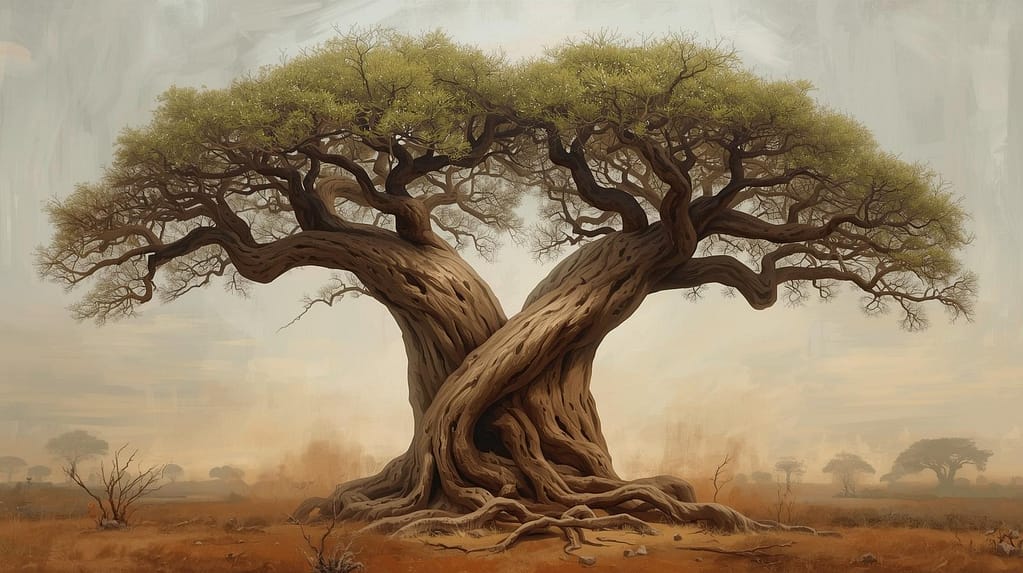
Connection does not always look like what we imagined. Sometimes roots meet beneath the surface long before branches intertwine in daylight. Old Baobabs often grow hollow with age. That hollow becomes a gathering place. Stories are told beneath it. Councils meet inside them. The emptiness becomes communal.
What if the spaces in you that feel hollow are not deficiencies? What if they are shelter? Perhaps even meeting places for others to feel safe and protected in.
The Wisdom of the Baobab in This Season
In our ‘Remembering when we were trees’ myth series for the Foundation of Self, we are not (just) romanticising trees. We are listening to them.
- Yggdrasil reminded us of cosmic interconnection.
- The Baobab reminds us of endurance.
- The Tree of Emergence reminds us that becoming human is a journey of rising, layer by layer, into new worlds.
The Baobab teaches that adaptation is not betrayal of your roots — it is protection of them. It teaches that comparison distorts, but relationship clarifies. It teaches that growth does not need to be visible to be powerful. And most of all, it teaches that being upside-down is not the same as being lost.
Perhaps the wisdom of the Baobab is this:
You do not need to change your shape to belong. You need to root into it. To store what nourishes you. You need to widen before you rise. And when drought comes — as it inevitably does — you will discover that you have been preparing all along.
That is the Foundation of Self. Not spectacle. Not perfection. Just quiet, ancestral endurance. Like the Baobab.