The Source of the Myth: Grímnismál and Wisdom Under Pressure
One of the most important sources for our understanding of Yggdrasil and the Nine Worlds is the Old Norse poem Grímnismál, found in the Poetic Edda. What makes this poem extraordinary is not only what it describes, but where it is spoken from. It is spoken through the voice of Grimnir, one of the many ‘faces’ of Odin. It portrays the wisdom of the Yggdrasil. Yet, it comes from a place of suffering, not victory
In Grímnismál, Odin speaks while he is imprisoned, tortured, and burned between fires. He is bound, disguised, and misunderstood. From this place of extreme suffering, he recites the structure of the cosmos: the nature of Yggdrasil, the Nine Worlds, and the laws that govern existence.
This detail matters deeply. In Norse mythology, wisdom does not arise from safety, detachment, or enlightenment as escape. Wisdom arises from ordeal. Knowledge is not revealed after suffering ends — it is articulated from within it.
The most striking line of the poem describes Odin’s initiation on the World Tree:
I know that I hung on a windswept tree,
nine long nights,
wounded with a spear,
dedicated to Odin,
myself to myself.
There is no external saviour in this story. Odin sacrifices himself to himself. This moment becomes the mythic root of self-trust — not as ego or bravado, but as authority forged through lived experience.
This is the foundation upon which Yggdrasil stands.
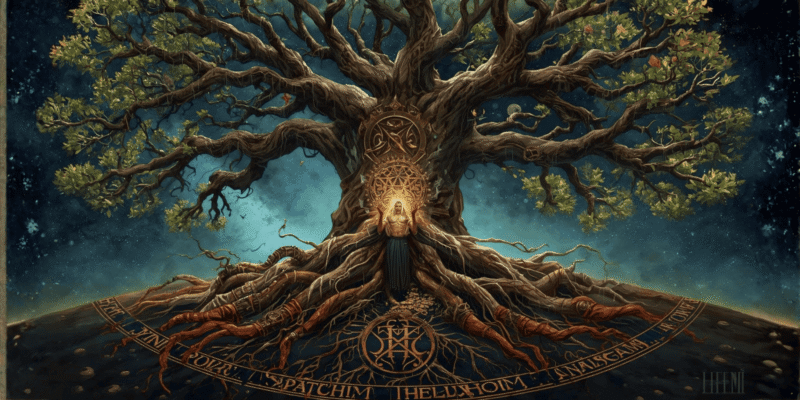
Yggdrasil is described as a vast ash tree whose branches stretch into the heavens and whose roots descend into deep, unseen realms. It is constantly under threat. Animals gnaw at its roots. Creatures strip its leaves. A dragon works endlessly at its base. And yet, the tree endures.
This is not a myth of perfection. It is a myth of resilience.
The Norse did not imagine stability as the absence of danger. They imagined stability as the capacity to remain standing while life applies pressure. This understanding aligns closely with the seasonal theme of Foundation of Self, which is not about becoming unshakeable, but about developing continuity through change.
Confidence, in this worldview, is not certainty. It is rootedness.
Odin’s Search for Wisdom and the Formation of the Self
Odin is not born wise. He seeks wisdom relentlessly and pays for it repeatedly. He sacrifices an eye at Mimir’s Well to gain depth of perception. Later, he sacrifices his sense of identity itself by hanging on Yggdrasil for nine nights, suspended between life and death.
This is an initiation, not a punishment.
Psychologically, this moment reflects a necessary stage in human development: the willingness to stay present when old identities dissolve, and new ones have not yet formed. This is where confidence is actually built — not through performance, but through endurance, humility, and trust in process.
Odin does not gain control through this act. He gains understanding. And understanding, in Norse myth, is always relational and embodied.
The Nine Worlds as Human Experience
The Nine Worlds woven through Yggdrasil are often described as separate realms, but symbolically they represent different dimensions of human experience. They are not destinations to reach or levels to ascend. They are inner landscapes we move through repeatedly across a lifetime.
Asgard represents meaning, values, and vision. It is where questions of purpose arise, and ideals are formed. When this realm is overemphasised, it leads to detachment and moral rigidity. When integrated, it provides orientation without superiority.
Midgard is the world of embodiment and relationship. It is where life is lived in practice rather than theory. Confidence that cannot survive Midgard — conflict, repair, limitation — is not embodied confidence.
Vanaheim reflects intuition, rhythm, and natural intelligence. It represents the body’s knowing and the capacity to trust timing rather than force outcomes. Confidence here feels easeful and responsive.
Muspelheim embodies passion, anger, and transformation. This is the realm of creative destruction, where old identities burn away. Suppressed fire becomes resentment; integrated fire becomes leadership and clarity.
Niflheim represents fear, freeze, and withdrawal. This realm teaches the wisdom of slowing down and respecting limits. Confidence here is not action, but presence.
Hel is the realm of endings and grief. It holds what has completed its cycle. This realm reminds us that confidence matures when loss is honoured rather than avoided.
Jotunheim represents inner opposition and overwhelming forces. The giants are not evil. They are unintegrated power. Confidence grows when resistance is met with curiosity instead of domination.
Alfheim reflects insight, creativity, and moments of lightness. It brings inspiration and meaning but must be grounded to avoid escapism.
Svartalfheim is the realm of shadow and craft. It represents slow inner work, pattern recognition, and honest self-confrontation. Confidence forged here is quiet, durable, and deeply trustworthy.
Together, these worlds describe a complete human life. Yggdrasil does not ask us to choose between them. It asks us to belong to all of them.
Foundation of Self and Confidence as Rooted Continuity
The seasonal theme of Foundation of Self is not about discovering a fixed identity. Yggdrasil makes this clear. The self is not static. It is a living system, shaped by time, relationship, loss, desire, fear, and renewal.
Confidence, from this perspective, is not bravado or certainty. It is the capacity to remain connected to oneself across changing inner worlds. It is known that no experience disqualifies you from belonging to the whole.
The Norse understood what modern culture often forgets: strength is not rigidity. Strength is flexibility rooted in depth.
When We Were Trees
Yggdrasil also reminds us of an older knowing. That wisdom grows slowly. That roots matter more than appearance. That life is not meant to be conquered, but tended.
When we were trees, we did not ask whether we were enough. We trusted the seasons. Endured the storms. We grew in relationship with everything that touched us.
And perhaps the invitation of this myth is simple:
to stop trying to stand above life,
and instead, to grow within it.
I love this so much!
Thank you. So do I! I really went so deep and can’t wait to explore more.